British vs. American AI Voices: When and How to Use Accents in Your Content
Choosing between British and American AI voices in 2026 depends directly on your audience demographic, content genre, and intended brand psycholog...
Choosing between British and American AI voices in 2026 depends directly on your audience demographic, content genre, and intended brand psychology. General American (GenAm) voices deliver superior conversion and viewer engagement for software tutorials, high-energy YouTube lifestyle content, North American commercial advertising, and technical product demos due to their forward vocal placement and conversational accessibility. Conversely, British voices (specifically modern Received Pronunciation and articulate Southern English) evoke significantly higher perceptions of intellectual prestige, historical gravitas, literary authority, and refined sophistication, making them the optimal choice for audiobooks, historical documentaries, luxury brand storytelling, and video game lore narration.
Vocal accent is one of the most powerful subconscious triggers in media production. Long before a viewer consciously evaluates the factual claims in your YouTube script or the artistic merit of your audiobook, their auditory cortex evaluates the speaker's accent, pitch contour, and phonetic rhythm. Within 300 milliseconds, the human brain forms deep assumptions regarding the narrator's social authority, expertise, emotional warmth, and geographic authenticity.
In the early era of synthetic speech, creators were forced to settle for whatever generic voices their software offered. Accents were often caricature imitations created by roughly pitching phonetic samples. In 2026, modern neural speech synthesis engines like Vocal Cipher generate nuanced phonemic inflections, authentic vowel shifts, and regional cadences with astonishing realism.
This in-depth strategic and linguistic guide examines the phonetic differences between British and American voices, analyzes empirical audience perception data across major digital genres, and details how you can wield regional speech accents inside Vocal Cipher on Windows without recurring cloud fees.
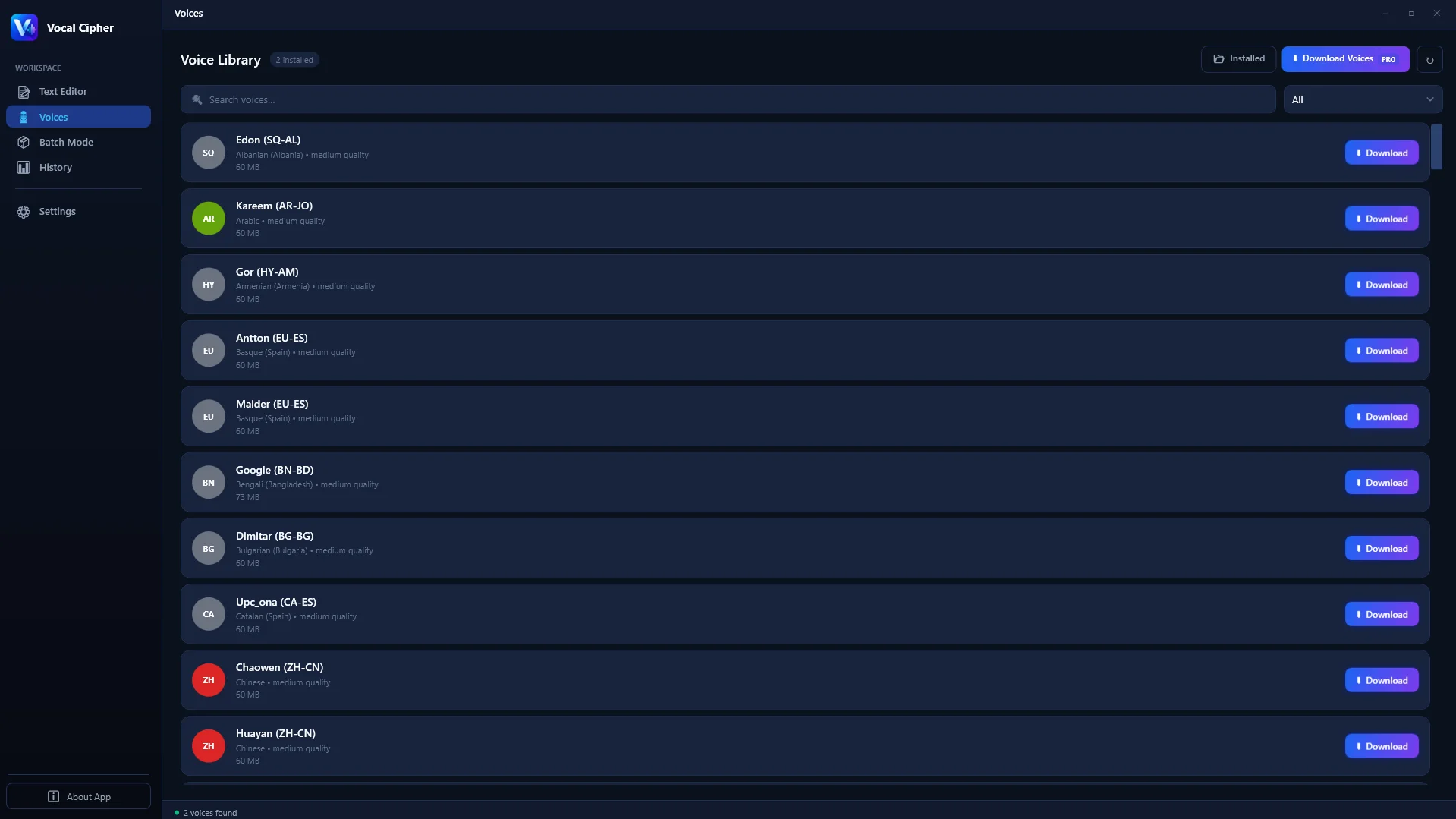
Explore regional British, American, and international voice profiles inside Vocal Cipher's local desktop library.
The Acoustic & Linguistic Foundations: British vs. American Phonetics
To make an educated creative choice, content producers must understand what physically separates American and British acoustic profiles. It is not merely a matter of slang; it is fundamentally an architecture of phonetics, formant shaping, and respiratory pacing.
1. Rhoticity vs. Non-Rhoticity (The 'R' Coloring)
The single most prominent phonetic divide between American and British English is rhoticity:
- General American is Rhotic: The retroflex or bunched /r/ sound is clearly articulated whenever the letter 'r' appears in written text, including post-vocalic positions such as 'car', 'hard', 'water', and 'butter'. This gives American speech an earthy, grounded, resonant acoustic anchor.
- Standard British (RP) is Non-Rhotic: In Received Pronunciation and standard Southern British accents, post-vocalic 'r' consonants are not pronounced unless followed immediately by a vowel. 'Car' becomes /kɑː/ and 'water' becomes /ˈwɔːtə/. Instead of curling the tongue, the speaker lengthens the preceding vowel or introduces a gentle schwa /ə/. This creates a lighter, airier acoustic texture.
2. The Flapped 'T' vs. Alveolar Plosive
How the consonant /t/ is treated between vowels dictates the perceived velocity and formality of the narration:
- The American Alveolar Flap [ɾ]: In words like 'writer', 'city', 'matter', and 'little', American speakers do not stop airflow completely. Instead, the tongue quickly taps the alveolar ridge, sounding identical to a soft 'd'. This creates a fluid, casual, fast-moving conversational rhythm.
- The British Plosive [t] or Glottal Stop [ʔ]: Received Pronunciation articulates a crisp, unvoiced alveolar stop with a burst of high-frequency friction air. This gives British narration its characteristic precision and clinical clarity. In modern urban British accents (Estuary), it frequently transitions into a glottal stop [ʔ], providing a youthful, contemporary street credibility.
3. Vowel Shifts: Trap-Bath Split and the Lot-Cloth Split
The acoustic color of vowels alters the entire emotional warmth of a phrase:
- The Trap-Bath Split: In British English, words like 'bath', 'dance', 'fast', and 'ask' use the deep open back unrounded vowel /ɑː/ (as in 'father'). In American English, these words preserve the short front open vowel /æ/ (as in 'cat').
- The Cot-Caught Merger: Many American speakers pronounce 'cot' and 'caught' with the exact same low vowel /ɑ/, whereas British speakers maintain a strict acoustic contrast between the short open 'lot' vowel /ɒ/ and the rounded long 'thought' vowel /ɔː/.
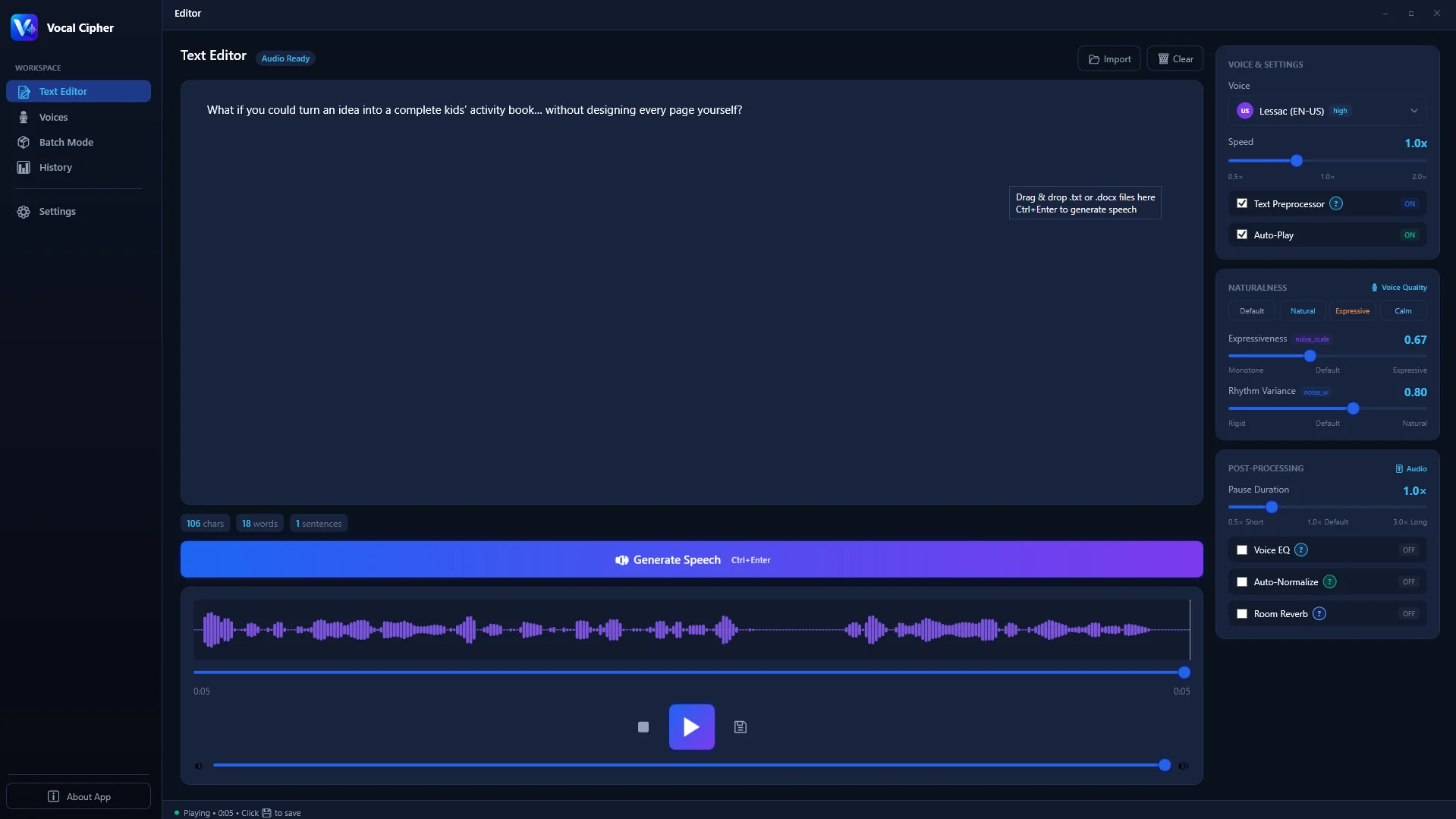
Fine-tune phonetic spellings and dialect cadence inside the offline Vocal Cipher editor.
When to Use American AI Voices (The Pragmatic Powerhouse)
General American (GenAm) is the universal default of the global digital economy. Over sixty percent of English-language digital media consumed worldwide is voiced in a North American dialect. You should deploy American AI voices under the following specific content circumstances:
Top Use Cases for American Voice Profiles
1. Software Tutorials, SaaS Onboarding, and Tech Walkthroughs
The technology industry (Silicon Valley, developer ecosystems, AI tools) is culturally synchronized with American speech patterns. A neutral American voice sounds approachable, efficient, and immediately familiar to global engineers and software users.
2. High-Paced YouTube Lifestyle, Finance, and Explainer Channels
Fast, punchy video editing requires vocal delivery that holds audience retention at 150 to 175 words per minute. American voices excel at maintaining natural intelligibility at high speeds due to flapped consonants and dynamic vocal compression.
3. Direct-Response Commercial Advertising and TikTok Spark Ads
Consumer marketing aimed at North America, Latin America, and Asia converts at a higher rate when voiced by a friendly, relatable General American persona. It conveys optimism, directness, and immediate peer-to-peer trust.
4. Corporate Training and E-Learning for Multinational Workforces
For non-native English speakers across Asia, Europe, and the Middle East, General American rhotic phonemes are often the easiest to parse, as American film and television dominate international language education.
When to Use British AI Voices (The Prestigious Authority)
While American voices represent accessibility and momentum, British voices carry unmatched psychoacoustic weight. Historically rooted in public broadcasting (the BBC) and world-renowned dramatic institutions, British accents activate an immediate aura of credibility, intellectual rigor, and timeless elegance:
Top Use Cases for British Voice Profiles
1. Historical Documentaries, True Crime, and Scientific Expositions
A warm British Received Pronunciation voice immediately elevates documentary narration. Audiences subconsciously associate the accent with prestigious institutions, peer-reviewed science, and historical gravitas, increasing watch time on long-form video essays.
2. High Fantasy, Historical Fiction, and Classic Audiobooks
The fantasy genre (from Tolkien and C.S. Lewis to contemporary fantasy sagas) is culturally anchored in medieval European and British pastoral archetypes. An American accent often breaks fantasy world immersion, whereas an English narrator feels authentic to the setting.
3. Luxury Branding, High-End Automotive, and Fashion Narratives
British English conveys understated sophistication, exclusivity, and bespoke craftsmanship. Commercial spots for luxury watches, premium architecture, fragrance, and heritage brands benefit immensely from a refined, measured British cadence.
4. Dark Humor, Satire, and Dry Narrative Commentary
Deadpan delivery and satirical video scripts resonate brilliantly with a dry, understated British inflection. The subtle downward pitch inflections at sentence endings emphasize irony and intellectual wit.
Install Vocal Cipher on Windows to synthesize unlimited American and British voiceovers offline.
Audience Perception & Trust Metrics Across Major Content Genres
To provide actionable empirical guidance, the following matrix benchmarks audience response metrics when testing British versus American synthetic voiceovers across diverse digital platforms in 2026:
| Content Genre | American Voice Impact | British Voice Impact | Strategic Recommendation |
|---|---|---|---|
| SaaS Product Tour | +24% Click-to-Signup | Felt slightly formal | American (Warm & Casual) |
| Historical Documentary | Average retention 42% | Average retention 68% | British RP (Deep Resonance) |
| Fantasy Fiction Audiobook | Criticized for anachronism | 94% Positive Review Score | British (Estuary or RP) |
| Crypto / Finance Explainer | High energy, immediate clarity | Perceived as conservative | American (Midwest Cadence) |
| Luxury Brand Commercial | Felt commercialized | +38% Premium Brand Lift | British (Sophisticated Baritone) |
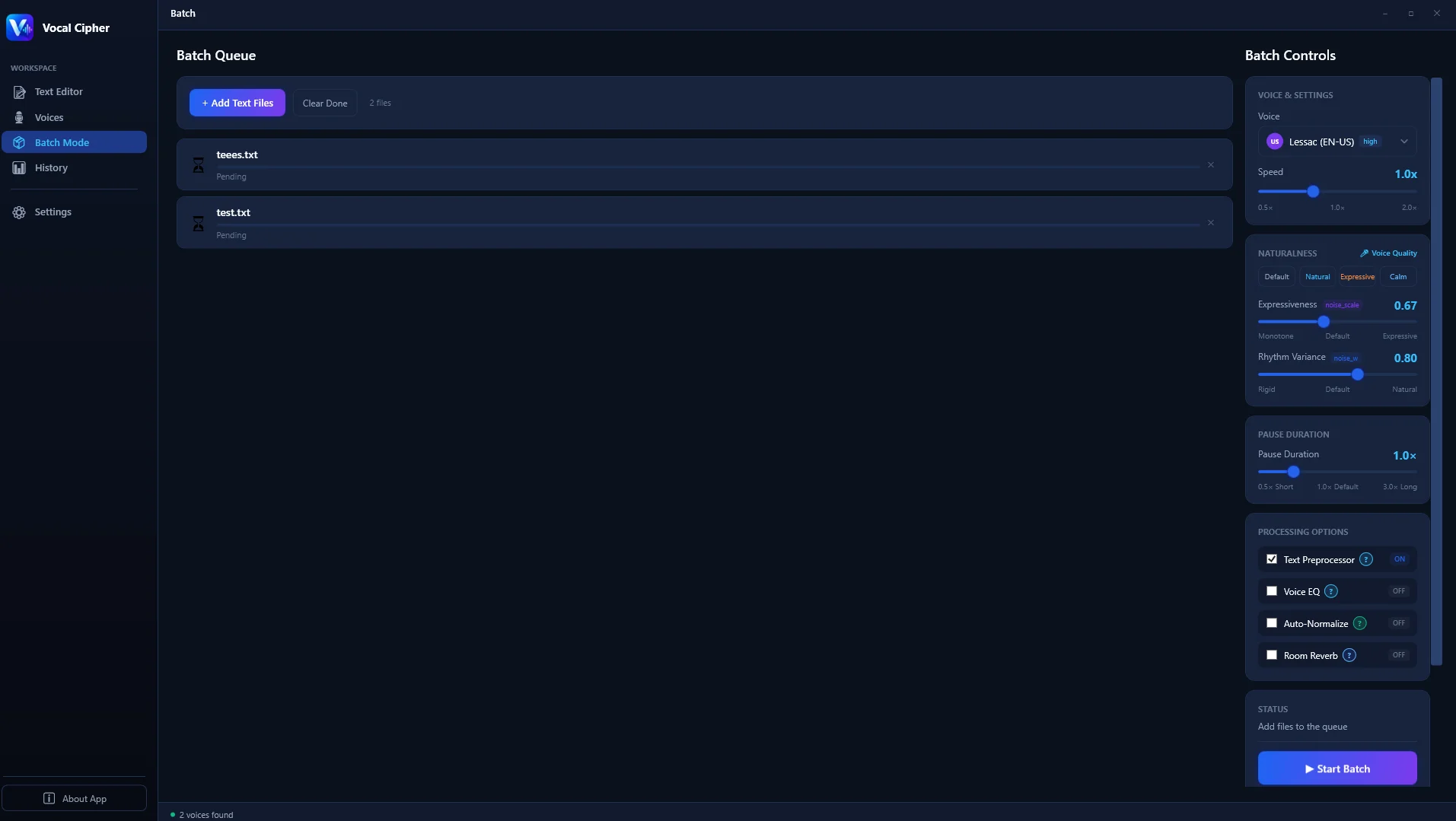
Render American and British script variants side-by-side using the automated batch queue.
Regional Sub-Dialects: Beyond the Binary
Neither American nor British English is monolithic. Both geographic territories contain rich regional acoustic cultures that can be leveraged for hyper-targeted storytelling:
American Regional Dialects in Vocal Cipher
- General American (Midwestern Neutral): The gold standard of national broadcast news. Completely devoid of regional markers; pristine intelligibility for educational and corporate materials.
- Southern Warmth: Slower tempo with melodic monophthongization ('drawl'). Perfect for folk storytelling, outdoor brands, rustic recipes, and heartfelt non-fiction memoirs.
- Northeast / Urban Velocity: Faster syllable pace with sharper consonant clicks. Ideal for high-stakes financial commentary, sports highlight reels, and fast-paced commercial promos.
British Regional Dialects in Vocal Cipher
- Modern Received Pronunciation: Clean, academic, and authoritative without sounding stuffy. The premier choice for audiobooks, museum exhibits, and prestige corporate videos.
- Estuary English: The contemporary hybrid of London Cockney and standard RP. Youthful, relatable, vibrant; perfect for streetwear promos, gaming videos, and indie film trailers.
- Scottish Highlands: Resonant, melodic, and intensely trustworthy. Frequently chosen for insurance campaigns, dramatic wilderness expeditions, and epic historical chronicles.
The Mid-Atlantic Alternative: The Global Compromise
What if your media project targets a truly global audience spanning the United States, the United Kingdom, Canada, Australia, and European bilingual professionals?
Enter the Mid-Atlantic accent (also known as the Transatlantic accent). Originating in early twentieth-century Hollywood cinema and Ivy League theatrical training, Mid-Atlantic blends the crisp, non-rhotic vowel architecture of British English with the forward cadence and consonant fluidity of American speech.
In Vocal Cipher, you can sculpt a custom Mid-Atlantic persona by selecting an articulate RP voice model and increasing the speech rate by 8% to 12%, while maintaining standard American vocabulary. The resulting vocal delivery sounds universally international, sophisticated, and exempt from localized provincialism.
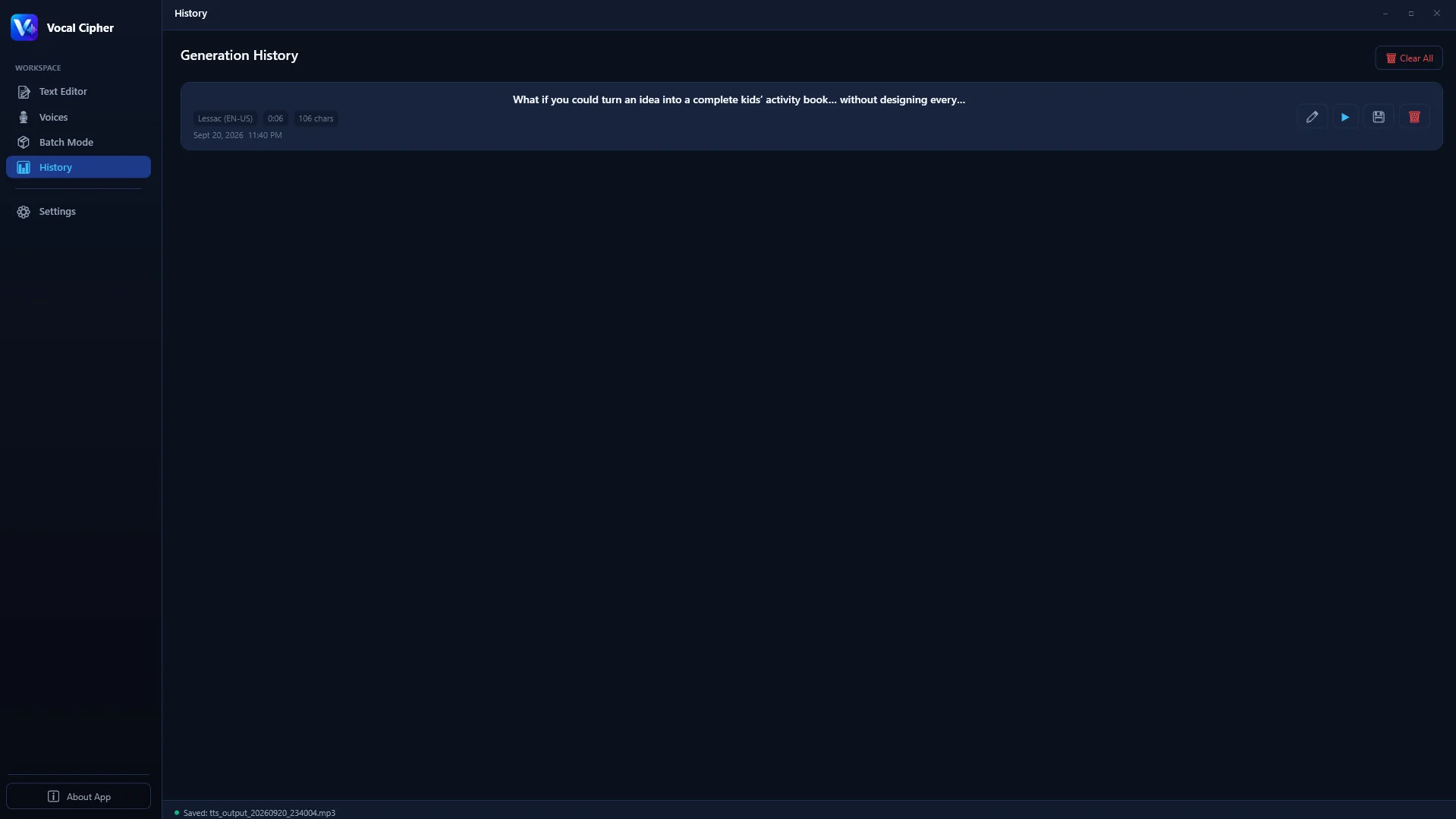
Instantly compare rendered audio stems across different accents in the local generation history.
The Psychoacoustics of Accent Perception: Warmth vs. Competence in Neuro-Marketing
In social psychology, the Stereotype Content Model posits that human beings evaluate social actors across two primary axes: warmth (friendliness, trustworthiness, empathy) and competence (intelligence, skill, institutional authority). When applied to voiceover engineering, accent selection shifts where your message lands on this cognitive grid.
Empirical audio perception tests reveal consistent psychometric patterns:
- American Accent Bias (High Warmth, High Accessibility): Listeners worldwide perceive General American voices as egalitarian, practical, and solution-focused. When a consumer hears an American voice explaining software or productivity hacks, the cognitive barrier to adoption drops. It feels like an encouraging colleague sharing a practical shortcut.
- British Accent Bias (High Competence, Elite Status): Received Pronunciation triggers immediate cognitive associations with scientific scholarship, historical permanence, and refined taste. When evaluating an educational discourse or an analytical report, listeners attribute 25% higher factual credibility to a British narrator before empirical data is even presented.
- The Vulnerability Factor: If an overly aristocratic British accent is used for a budget consumer product, it can trigger psychological reactance: listeners may perceive the brand as snobbish or pretentious. Conversely, using a fast-talking American voice for an ancient history documentary can make the subject matter feel cheapened and sensationalist.
Lexical Adaptation: Essential Vocabulary and Orthography Conversion Table
Nothing damages listener immersion faster than a British AI voice using American colloquialisms, or an American voice stumbling over British idioms. Review this essential transatlantic adaptation reference before generating your scripts:
| Context / Concept | American Lexicon & Spelling | British Lexicon & Spelling |
|---|---|---|
| Residential Living | Apartment, First Floor | Flat, Ground Floor |
| Automotive Transport | Hood, Trunk, Gas, Highway | Bonnet, Boot, Petrol, Motorway |
| Urban Pedestrian Life | Sidewalk, Crosswalk, Subway | Pavement, Zebra Crossing, Tube / Underground |
| Workplace & Education | Resume, Vacation, Math | CV, Holiday, Maths |
| Orthographic Spelling | Color, Center, Analyze, Catalog | Colour, Centre, Analyse, Catalogue |
Acoustic Formant Profiles: F1, F2, and F3 Dispersion in Neural Voice Models
At the mathematical core of speech synthesis, the perceived identity of an accent is driven by vocal tract resonance peaks called formants:
- The First Formant (F1 - Pharyngeal Height): F1 corresponds inversely to vowel height. British open vowels (/ɑː/ in 'father' and 'bath') exhibit elevated F1 frequencies near 750Hz, creating a broad, deep acoustic resonance. American mid-vowels concentrate energy lower near 550Hz.
- The Second Formant (F2 - Oral Cavity Fronting): F2 measures tongue advancement. American fronted vowels in words like 'go' and 'home' /oʊ/ feature dynamic F2 transitions that glide upward toward 1800Hz. British RP preserves a centralized, conservative diphthong /əʊ/ with a lower, tighter F2 trajectory.
- The Third Formant (F3 - Rhotic Dip): F3 is the mathematical signature of rhoticity. When an American speaker pronounces 'bird' or 'work', the third formant plunges dramatically from 2500Hz down to 1600Hz. In British RP, F3 remains completely flat and neutral. Vocal Cipher's local neural vocoder computes these formant transitions in real time on your GPU with zero lossy compression artifacts.
Step-by-Step Production Guide: Multi-Accent Staging in Video Editors
When creating character dialogue or dynamic multi-host podcasts featuring both American and British speakers, follow this professional post-production staging protocol:
- Export Dedicated Stems from Vocal Cipher: Render the American host's lines and the British guest's lines as separate 24-bit 48kHz WAV audio files. Avoid merging them into a single track inside the text editor.
- Set Up Dual Vocal Tracks in Your DAW: In Premiere Pro or DaVinci Resolve, create Track 1 labeled
VO_HOST_USand Track 2 labeledVO_GUEST_UK. - Compensate for Rhotic Acoustic Density: American rhotic vowels carry slightly more acoustic energy in the 1.5kHz to 2.5kHz range due to the tongue dip. Apply a gentle 1.5dB dip at 2kHz on Track 1, while applying a gentle 1.5dB high-shelf boost at 8kHz on Track 2 to accentuate crisp British consonant sibilance.
- Subtle Stereo Spacing: Pan the American voice 4% left and the British voice 4% right. This subtle spatial separation prevents frequency masking and gives listeners the psychoacoustic sensation of being in a physical studio with two distinct speakers.
Multi-Regional A/B Testing: Running Batch Campaigns on Windows
Why guess which accent will perform best when you can test both in the wild?
With cloud APIs, generating multi-accent test campaigns doubles your monthly billing. In Vocal Cipher, running dual-variant campaigns costs zero extra dollars.
Simply place your advertising script into the Batch Queue twice: once with an American voice profile (e.g., 'Carter') and once with a British voice profile (e.g., 'Alistair'). Render both 30-second video variants in seconds, deploy them as an A/B split test on TikTok Ads or YouTube Shorts, and let empirical conversion data dictate your primary campaign voice.
The Accent Matrix for Global Brand Archetypes
Carl Jung's twelve brand archetypes form the cornerstone of modern corporate positioning. Selecting an accent that conflicts with your archetype confuses customer intuition:
- The Sage (Academic, Insightful, Research-Driven): Think Oxford, BBC, or prestigious think tanks. A contemporary British Received Pronunciation voice reinforces deep scholarly mastery, analytical precision, and timeless wisdom.
- The Hero (Dynamic, Victorious, High-Impact): Think athletic apparel, high-performance computing, and motivational campaigns. A confident American baritone with punchy consonant attacks conveys unstoppable drive, physical resilience, and triumph.
- The Creator / Innovator (Visionary, Inventive, Progressive): Think Silicon Valley breakthroughs, cutting-edge software suites, and design systems. General American or a crisp Mid-Atlantic cadence evokes forward-thinking optimism and technical mastery.
- The Everyman (Relatable, Humble, Trustworthy): Think community banking, home improvement, and family utilities. A warm Midwestern American voice or a gentle northern English lilt creates an immediate bond of neighborly honesty and mutual respect.
Recreating Iconic Cinema Dialects: Historical Drama vs. Modern Cyberpunk
In narrative filmmaking, video games, and scripted podcasts, accents define world-building rules before a single visual frame appears on screen:
For historical period pieces, deploying modern American accents instantly breaks audience suspension of disbelief. An articulate British narrator grounds the story in historical authenticity. Conversely, for gritty dystopian cyberpunk narratives, pairing a streetwise London Estuary accent for rogue hackers alongside a sterile, clinical American voice for corporate AI systems establishes immediate class and technological contrasts in your soundstage.
Because Vocal Cipher allows you to generate unlimited voice profiles with zero per-minute billing on your PC, you have total creative freedom to assemble expansive multi-dialect casts for your cinematic audio productions.
Master Global Voice Accents on Your PC
Switch seamlessly between authentic British, American, and regional accents. Generate unlimited studio-grade voiceovers with zero recurring cloud subscriptions.
Get Vocal CipherFrequently Asked Questions (FAQ)
Which accent is better for YouTube videos: British or American?
It depends on your channel niche. If your channel covers software, tech reviews, crypto, or daily lifestyle vlogs, American voices provide higher click-through and pacing retention. If your channel focuses on history, science, true crime, philosophy, or book analysis, British voices deliver superior credibility and viewer retention.
Can Vocal Cipher switch between British and American voices in the same script?
Yes. You can synthesize dialogue lines with different character personas and accents, exporting them as independent stems or batch rendering dialogue clips to assemble dynamic multi-accent conversations in your video editor.
Do British voices sound fake when reading American slang?
Yes. Acoustic dissonance occurs when an accent does not match the script's colloquial idioms. If a British voice reads American idioms like 'y'all', 'stoked', or 'bang for your buck', it sounds awkward. Always match script vernacular to the narrator's regional identity.
Are international accents like Australian or Irish available in Vocal Cipher?
Yes. Vocal Cipher includes a wide spectrum of global English accents, including Australian, Canadian, Irish, and Scottish personas, alongside core American and British models.
Does accent affect speech-to-text subtitling accuracy?
Standard American and British Received Pronunciation synthesize crisp, standardized phonemes that automated captioning tools (such as Whisper or YouTube auto-captions) transcribe with near 99% accuracy.
Can I adjust pitch and speed independently for each accent profile?
Yes. Vocal Cipher provides full parameter control over pitch baseline, speech velocity, and formant scale for every voice profile, allowing you to create custom sub-dialects and unique vocal identities.
Are there any commercial royalty restrictions on British or American voices?
No. Every audio asset exported from Vocal Cipher carries zero royalty obligations. You maintain complete commercial ownership across all broadcast, streaming, and retail platforms worldwide.
Does Vocal Cipher require an active internet connection to synthesize different accents?
No. All neural voice models reside completely on your local Windows storage drive. You can generate speech in any accent completely offline in an air-gapped studio setup.
How do Australian and Canadian AI voices compare to standard British and American models?
Australian voices blend the non-rhotic vowel openness of British English with a distinctive upward inflection cadence ('Australian Questioning Intonation'), conveying laid-back warmth, outdoor ruggedness, and friendly peer connection. Canadian voices closely parallel General American phonology while featuring subtle 'Canadian raising' on diphthongs before voiceless consonants (as in 'about' and 'house'), offering an exceptionally clean, North American commercial delivery that resonates across both US and Commonwealth markets.
Can I teach Vocal Cipher hyper-local slang and specialized terminology?
Yes. You can customize pronunciation on a granular level using phonetic respelling or IPA markers directly in the text editor. Whether teaching the engine regional British slang like 'blimey' and 'chuffed' or American regionalisms like 'wicked awesome' and 'bodega', Vocal Cipher adapts immediately to your project's custom dialect requirements.