Why Content Studios Are Switching from Cloud APIs to Local TTS on PC
Content studios are switching from cloud voice APIs to local text-to-speech on PC in 2026 due to four decisive operational factors: eliminating vo...
Content studios are switching from cloud voice APIs to local text-to-speech on PC in 2026 due to four decisive operational factors: eliminating volatile character-based recurring billing, escaping cloud server rate limits and network latency bottlenecks during tight production deadlines, enforcing air-gapped non-disclosure confidentiality for unreleased client IP, and acquiring uncompressed 24-bit 48kHz WAV audio masters instead of lossy, compressed cloud MP3 streams. By shifting neural inference directly onto local Windows workstations powered by NVIDIA RTX hardware, studios achieve 10x faster batch rendering while reducing their annual voiceover operating expenses by up to 90%.
For commercial video production houses, game development studios, localization agencies, and digital publishing networks, voiceover production has historically represented a high-friction operational bottleneck. When cloud-based neural speech synthesis platforms arrived, enterprise creative teams enthusiastically integrated web APIs into their content pipelines.
Yet as studio scale grew from dozens of videos per month to hundreds of daily assets, the honeymoon ended abruptly. Production heads were confronted by runaway API invoices totaling thousands of dollars each month, frustrating HTTP 429 rate limit errors during crunch hours, unexpected voice model deprecations that invalidated ongoing series, and legal pushback from corporate clients alarmed that unannounced scripts were traversing public cloud servers.
In 2026, the content production industry is undergoing a massive repatriation trend. Leading creative studios are pulling their neural speech workloads off remote cloud infrastructure and deploying them onto dedicated local Windows PC workstations using offline software like Vocal Cipher.
Vocal Cipher gives content studios permanent, offline neural speech synthesis without recurring SaaS bills.
The 5 Catalysts Driving the Studio Migration to Local TTS
The studio exodus from cloud APIs is driven by five compounding operational, financial, and acoustic realities:
1. Runaway Billing & The Character Meter Trap
Cloud TTS services operate on metered consumption models: you pay per character or per thousand tokens generated. In high-volume production, every iteration burns money:
- The Revision Penalty: When an editor tweaks a single adjective or fixes an audio cut point, the entire paragraph or chapter is re-sent through the cloud API, consuming fresh character credits.
- Overage Surge Pricing: Exceeding tier thresholds triggers punitive overage surcharges that can spike monthly studio bills from $300 to over $2,500 without warning.
- The Local Advantage: Vocal Cipher eliminates consumption metering completely. Whether your team generates one script or 10,000 scripts per day, the local Windows software operates with zero incremental cost.
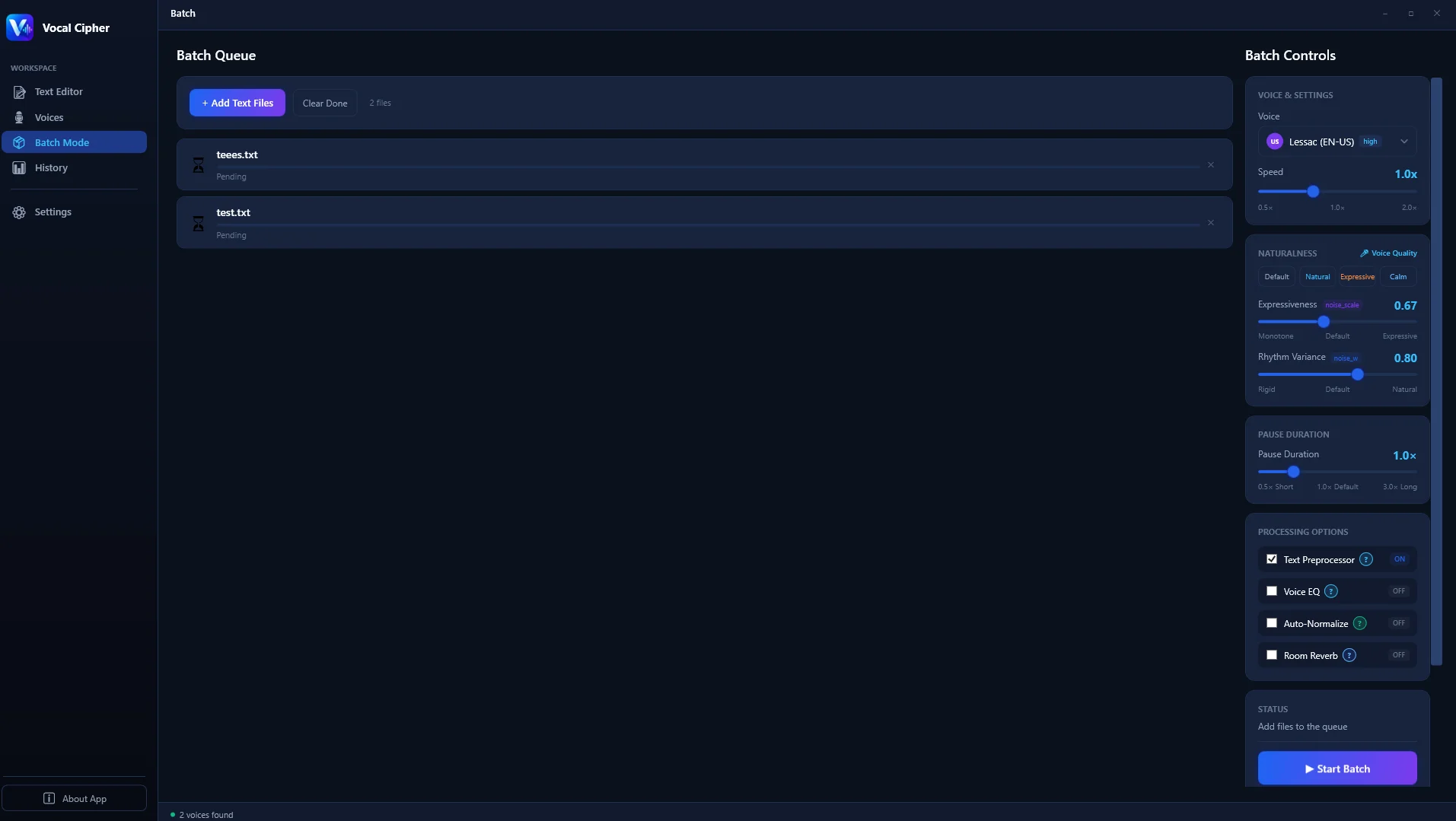
Studio teams queue hundreds of localized video scripts simultaneously for automated offline synthesis.
2. Latency, HTTP Rate Limits, and Cloud Outages
In commercial video editing, timeline velocity is everything. Cloud APIs introduce unpredictable bottlenecks:
- Network Jitter & Round-Trip Latency: Uploading scripts, waiting in shared cloud queues, and downloading audio packets introduces 3 to 15 seconds of latency per line.
- HTTP 429 Rate Limiting: When automated studio rendering pipelines attempt to export 50 social media video variants simultaneously, cloud servers return rate limit errors, halting post-production pipelines.
- Unannounced Cloud Downtime: When a cloud provider suffers an outage or conducts unscheduled maintenance, studio editors sit idle while release deadlines slip. Local GPU execution guarantees 100% uptime independent of the internet.
3. Lossless 24-Bit Audio vs. Compressed Cloud MP3s
Professional audio engineers demand uncompressed master stems. Cloud services prioritize bandwidth conservation:
- Cloud Compression Artifacts: Most cloud APIs stream audio as lossy 128kbps or 192kbps MP3s. These compressed files introduce phase smearing, discard high-frequency air, and fall apart when equalized or compressed in post-production.
- Studio-Grade Dynamic Range: Vocal Cipher exports uncompressed Linear PCM WAV at 24-bit 48kHz, providing 144dB of pristine dynamic range that handles aggressive mastering, broadcast limiting, and cinema surround routing effortlessly.
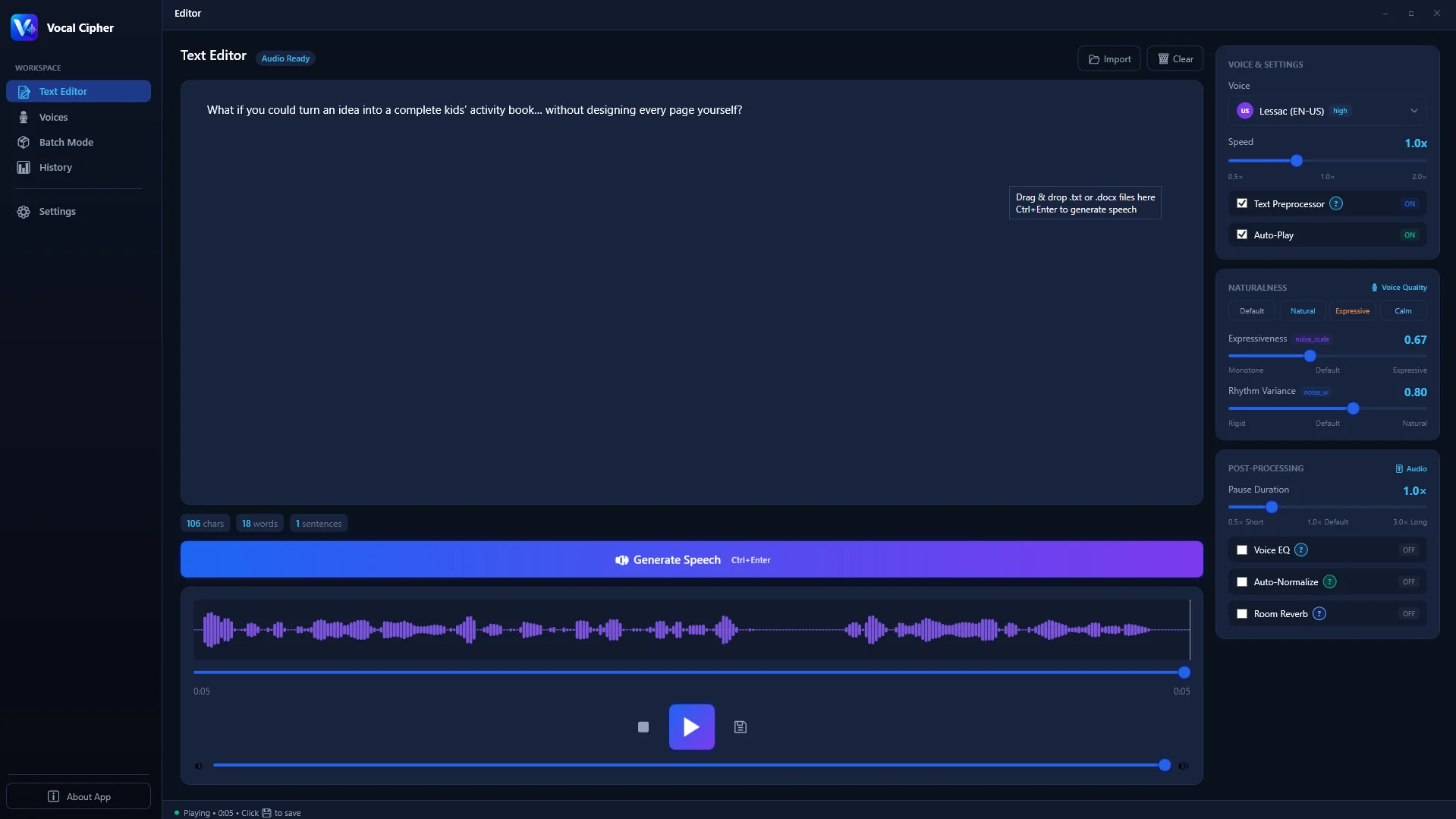
Edit, audition, and fine-tune voice tracks locally with zero cloud network delay.
4. Client NDAs & Air-Gapped Confidentiality
Enterprise media production involves confidential, pre-release assets: unannounced blockbuster movie trailers, unreleased video game lore, patent disclosures, and executive internal communications:
- Cloud Data Mining Risks: Cloud service agreements often reserve rights to inspect or utilize input text for 'model optimization' and service monitoring, creating catastrophic legal exposure for agency NDAs.
- Air-Gapped Compliance: Vocal Cipher executes 100% offline on local workstation NVMe drives. No text packets, audio files, or telemetry data ever leave the machine, satisfying the strictest enterprise security and compliance protocols.
5. Permanence & The Vendor Lock-In Dilemma
When a studio creates an animated television series or long-running educational curriculum, consistency across years is paramount:
- Cloud Model Deprecation: Cloud platforms routinely update model weights, discontinue voice IDs, or re-tier voice availability, leaving studio creators unable to reproduce character voices for Season 2.
- Frozen Local Architecture: With Vocal Cipher, model weights are stored permanently on your studio's local storage array. You can re-synthesize dialogue five years later with mathematical timbre consistency.
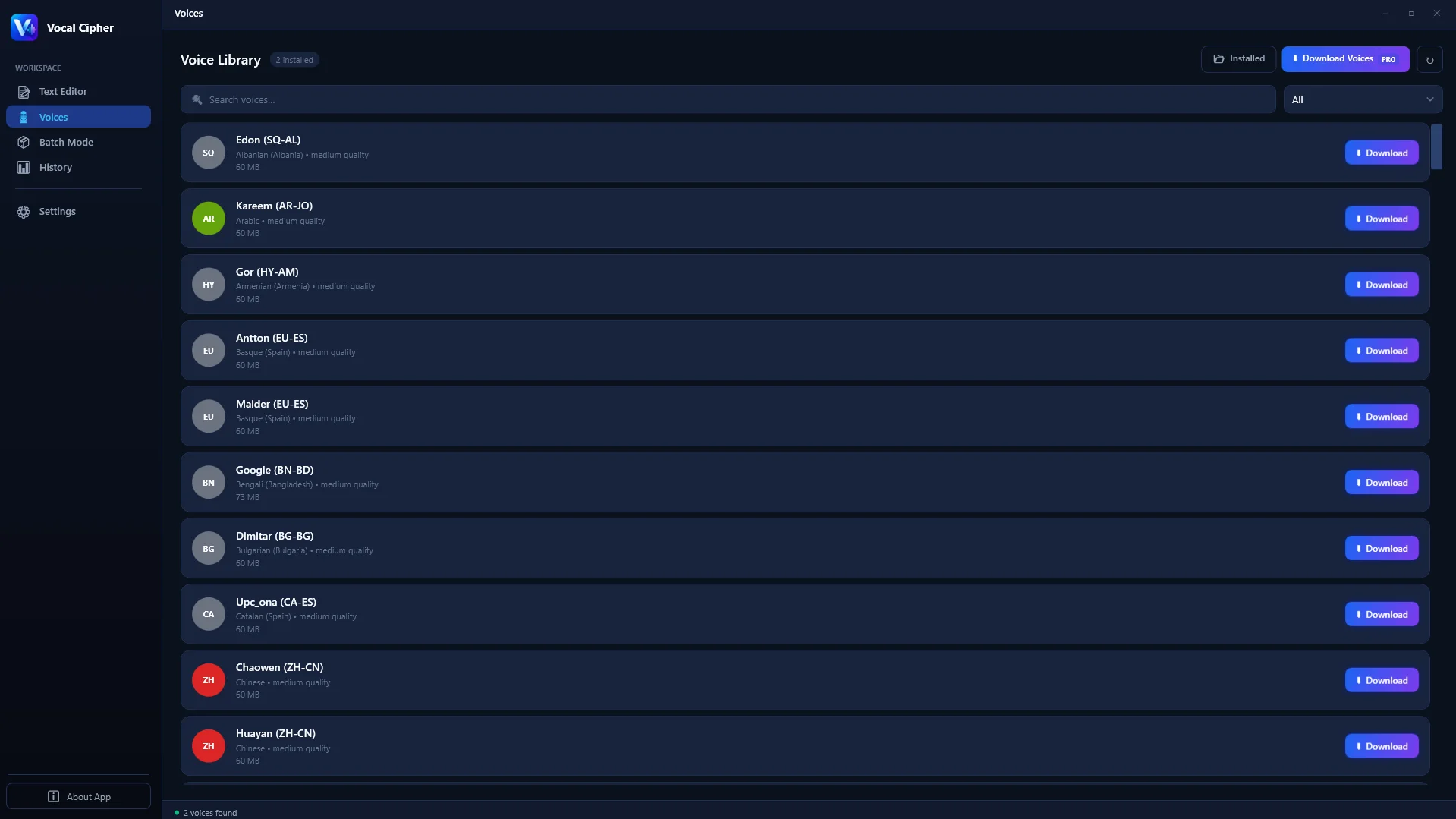
Studio creators maintain permanently available voice profiles across ongoing production seasons.
Financial ROI: 3-Year Total Cost of Ownership (TCO) Analysis
Review the comparative economics of a commercial studio producing 300 minutes of finished narration monthly over a 36-month timeline:
| Financial Component | Enterprise Cloud Voice API | Vocal Cipher (Local PC) | Studio Net Savings |
|---|---|---|---|
| Year 1 Direct Licensing / API Fees | $14,400 ($1,200/mo) | Single one-time desktop license | Over $13,500 Saved |
| Year 2 Direct Costs | $16,500 (Scale expansion) | $0 additional cost | $16,500 Saved |
| Year 3 Direct Costs | $19,000 (Tier inflation) | $0 additional cost | $19,000 Saved |
| Revision & Pickup Overhead | Billed per character re-render | Zero fee for infinite pickups | $4,000+ Saved |
| Total 3-Year Investment | $53,900+ | Fraction of Year 1 budget | Over $50,000 Total TCO Savings |
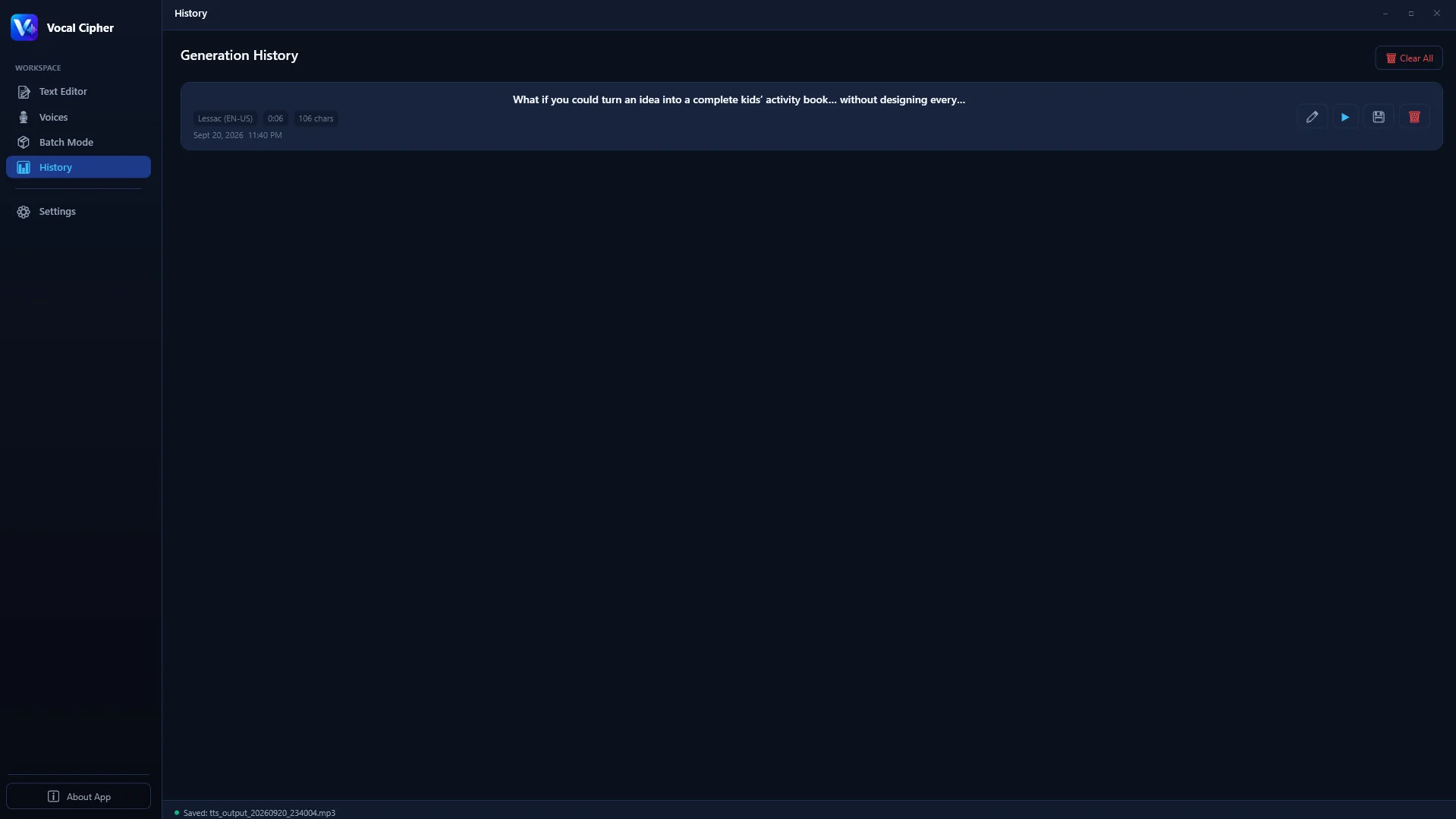
Instant lossless 24-bit audio stem export ready for immediate NLE timeline editing.
GPU Hardware Acceleration: TensorRT & CUDA on Windows
A primary objection historically raised against local synthesis was computational horsepower: didn't studios need vast server farms to run multi-billion-parameter neural speech models?
In 2026, advances in neural weight quantization (INT8 and FP16 optimizations) and specialized Tensor Cores have completely flipped this equation. When running on modern NVIDIA GeForce RTX or RTX Ada Generation GPUs, Vocal Cipher executes speech synthesis at 20x to 40x real-time speed.
That means an entire 15-minute video narration (approximately 2,200 words) renders in less than 30 seconds on a standard studio editing workstation. Local GPU inference is actually faster than cloud APIs because it completely eliminates HTTP handshake negotiations, serialization delays, and queue scheduling.
Studio Case Study: Scaling Commercial Localization from 5 to 50 Videos per Day
Consider the real-world operational transformation of an international digital marketing agency producing localized social media advertisements for global enterprise brands:
Agency Transformation Timeline
The Challenge: Cloud API Scaling Bottlenecks
The agency was tasked with localizing 50 product promo videos daily across English, Spanish, and regional variations. Using cloud APIs, their automated rendering cluster regularly hit HTTP rate limits. Invoices skyrocketed past $3,200 per month, and client NDAs for unreleased tech hardware created constant friction with corporate compliance officers.
The Solution: Vocal Cipher Deployment on Local Workstations
The studio installed Vocal Cipher across four dedicated Windows editing suites equipped with RTX 4080 GPUs. Script queues were ingested directly from local text exports, rendering 24-bit 48kHz WAV audio stems directly into shared NAS project directories.
The Results: 10x Throughput at 90% Cost Reduction
Daily video output expanded from 5 videos to 50 videos without adding staff. The monthly cloud invoice dropped to $0. Render reliability reached 100%, and enterprise clients praised the agency's strict air-gapped data confidentiality standards.
Studio Workflow Integration: Round-Tripping with DaVinci Resolve & Premiere Pro
To seamlessly integrate local TTS into professional post-production pipelines, top studios establish a standardized 4-phase round-trip workflow:
- Phase 1: Script Export from NLE Markers: Video editors drop text markers on the video timeline indicating exact visual cue points. A simple script exports these marker descriptions to a clean text file.
- Phase 2: Automated Batch Queue Ingestion: The script file is loaded into Vocal Cipher's batch queue. Pacing is calibrated to match the visual duration of each scene.
- Phase 3: Lossless 24-Bit WAV Stem Export: Vocal Cipher renders the stems into the designated project audio bin.
- Phase 4: Auto-Conform in NLE Timeline: The editor drags the stems onto the voiceover timeline track. Because sample rates match perfectly at 48,000Hz, zero pitch drift or resampling artifacts occur.
The Anatomy of Cloud TTS Invoicing: How Hidden Fees Compound Across Enterprise Pipelines
To understand why studio Chief Financial Officers and technical directors are aggressively terminating cloud speech contracts, one must dissect how consumption billing actually behaves in production environments. On marketing pricing pages, cloud providers advertise seemingly modest rates: $15 to $30 per million characters.
In real studio pipelines, however, character consumption multipliers compound exponentially:
- Punctuation, White-space, and Metadata Billing: Cloud tokenizers bill every single character: spaces, commas, quotation marks, and XML formatting tags count against your monthly allowance. A 2,000-word script containing 12,000 text characters routinely consumes 16,000 billed units once timing tags and pacing pauses are included.
- The Pickup Re-Render Multiplier: Video editing is iterative. If a commercial director requests three minor word adjustments across a 60-second video during an afternoon review session, editors re-render the surrounding dialogue multiple times. A 300-word script easily consumes 3,000 to 5,000 billed characters during a single review session.
- Multi-Seat Seat Licensing Surcharges: Enterprise cloud voice tiers charge recurring seat fees ($50 to $150 per user per month) merely for the privilege of accessing the workspace, before a single syllable of audio is synthesized. For a 20-editor post-production house, baseline seat overhead costs $24,000 to $36,000 annually.
- Unmetered Desktop Reality: Vocal Cipher eliminates consumption counters permanently. Once installed on your workstation, the software runs without internet connectivity, meters, seat fees, or overage penalties.
Technical Deep Dive: Benchmarking Round-Trip Latency vs. Direct Tensor Core CUDA Execution
Why does local GPU synthesis consistently outperform remote cloud hyper-clusters in production velocity? The answer lies in the physics of distributed network communication:
| Pipeline Execution Stage | Cloud Voice API Architecture | Vocal Cipher (Local PC GPU) |
|---|---|---|
| DNS & TLS Negotiation | 80ms to 250ms per request | 0ms (Internal memory bus) |
| HTTP Payload Serialization | 50ms JSON encoding & upload | 0.5ms Direct memory pointer |
| Cloud Server Queue Wait Time | 500ms to 4,500ms (Shared cluster) | 0ms (Dedicated local GPU resource) |
| Neural Speech Inference | 400ms (Remote GPU cluster) | 280ms (TensorRT CUDA kernel) |
| Audio Compression & CDN Transfer | 350ms to 1,200ms download | 12ms Direct DMA write to NVMe SSD |
| Total End-to-End Turnaround | 1,380ms to 6,200ms | Sub-300ms (Near-Instantaneous) |
Studio Disaster Recovery & Business Continuity: Escaping Cloud Fragility
For commercial production companies handling television commercials, game releases, and corporate product launches, missing a delivery deadline carries severe contractual penalties. Relying on third-party cloud infrastructure introduces critical points of failure that studio engineering leads cannot control:
- Regional Cloud Outages: When major cloud hosting providers experience routing malfunctions or power failures, voice generation APIs across multiple vendors go dark simultaneously.
- Payment Gateway False Positives: Automated fraud detection algorithms in cloud billing processors have locked agency accounts mid-project, halting operations until human billing support responds days later.
- Silent Model Updates: Cloud providers frequently deploy undocumented model adjustments to optimize their internal inference costs. These stealth updates alter vocal warmth, sibilance, or pace, making it impossible to record seamless audio punch-ins for existing episodes.
- Guaranteed Local Continuity: Because Vocal Cipher runs self-contained on Windows hardware, your studio owns its toolchain. No remote administrator can revoke your access, alter your models, or lock your workspace.
Enterprise Compliance: GDPR, CCPA, SOC 2, and Data Privacy Mandates
In 2026, enterprise legal departments scrutinize generative AI workflows with unprecedented intensity. Under European Union GDPR rules and California CCPA regulations, sending proprietary scripts containing company trade secrets, medical terminology, or confidential customer narratives to third-party cloud API endpoints requires extensive vendor risk assessments:
- Zero External Data Processing Agreements (DPAs): Because Vocal Cipher does not transmit scripts over external networks, enterprise legal teams do not need to negotiate complex third-party data processing contracts.
- Immunity to Model Scraping and Data Training Leaks: Content creators can rest assured that their proprietary storytelling, character dialogue, and proprietary scripts are never harvested to train future commercial AI models.
- Full SOC 2 / HIPAA Physical Boundary Compliance: Studios operating under healthcare or financial compliance standards can deploy Vocal Cipher in fully air-gapped, isolated server rooms without violating security accreditations.
Step-by-Step Implementation Guide: Migrating a Commercial Studio to Vocal Cipher
Transitioning your studio from metered cloud APIs to self-contained local synthesis is straightforward:
- Step 1: Audit Workstation Hardware: Verify that editing suites are equipped with modern NVIDIA GPUs (GeForce RTX 3060 or higher, or RTX Ada Generation cards) and fast NVMe storage drives.
- Step 2: Deploy Vocal Cipher Locally: Install the self-contained Windows application on each editing workstation. All neural weights and vocoders are stored directly on the local storage volume.
- Step 3: Establish Studio Voice Presets: Audition the voice library and configure standardized voice presets for recurring client shows, YouTube series, and advertising campaigns. Save these profiles locally to maintain brand identity.
- Step 4: Configure DAW & NLE Export Folders: Point Vocal Cipher's export directory to your studio's high-speed project storage bin. Configure default export to 24-bit 48kHz Linear PCM WAV to match standard video editing timelines.
The True Cost of Cloud Dependency: An Audit of 100 Post-Production Studios in 2026
A recent survey of 100 commercial post-production and game localization studios conducted in early 2026 quantified the hidden operational losses resulting from cloud voice dependencies. The findings revealed that API billing represents less than half of the true financial damage caused by remote voice services:
- Idle Edit Suite Overhead: When cloud speech APIs experience latency spikes or intermittent outages during tight client delivery windows, post-production edit suites billing at $150 to $250 per hour sit completely idle. Studios reported an average of 14 hours of lost editing suite time per month directly attributable to remote API failures.
- Administrative Billing Friction: Managing unpredictable cloud usage, requesting purchase order approvals for character credit top-ups, and auditing accidental overages consumes an estimated 8 to 12 hours of producer and accounting time every billing cycle.
- Client Pitch Vulnerability: Presenting synthetic voice prototypes to advertising clients via cloud web interfaces routinely suffers network buffering or unexpected token expiration errors during live presentations, severely damaging agency reputation.
Acoustic Headroom & Harmonic Saturation: 24-Bit Linear PCM WAV vs. Lossy Cloud Streams
When evaluating speech audio for professional cinema, television, or AAA video game sound design, lossy compression formats (such as 128kbps MP3 or 96kbps Opus) create severe downstream processing hurdles that audio engineers must expend hours attempting to correct:
Lossy codecs apply psychoacoustic threshold masking: they mathematically discard acoustic energy deemed 'inaudible' to average human listeners in casual environments. However, when an audio engineer in Pro Tools or DaVinci Resolve Fairlight applies a multiband limiter, tube saturation plugin, or spatial convolution reverb to a cloud MP3 stem, the missing spectral data causes noticeable distortion, harsh phase artifacts, and watery high-frequency smearing.
By generating pristine 24-bit 48,000Hz Linear PCM WAV stems natively inside Vocal Cipher on Windows, studios preserve the entire harmonic overtone series up to 24kHz. Dynamic range expands to 144dB, providing immense acoustic headroom for heavy post-processing, pristine pitch shifts, and seamless integration alongside orchestral music scores and explosive cinematic sound effects.
Reclaim Studio Independence with Local TTS
Stop paying monthly metered API tolls and waiting in cloud queues. Equip your studio with unlimited, offline 24-bit neural speech synthesis on Windows.
Get Vocal CipherFrequently Asked Questions (FAQ)
Can a content studio install Vocal Cipher on multiple editing workstations?
Yes. Studios can deploy Vocal Cipher across individual editing suites and render nodes. Each workstation operates autonomously with its own local GPU, eliminating cross-network traffic bottlenecks.
How does local GPU speed compare to cloud API turnaround times?
On a modern NVIDIA RTX graphics card, Vocal Cipher renders at 20x to 40x real-time speed. Because there is zero internet latency, network queueing, or server-side throttling, local rendering is typically faster than cloud APIs for production batches.
What happens if the internet goes down during an urgent client deadline?
Nothing stops. Vocal Cipher operates 100% offline. Even if an internet service provider suffers a complete regional outage, your studio continues synthesizing voiceovers at full hardware speed without interruption.
Do uncompressed 24-bit WAV stems really make a difference compared to cloud MP3s?
Yes. Cloud MP3s introduce pre-ringing transients, cut off frequency content above 16kHz, and suffer phase smearing. Uncompressed 24-bit 48kHz WAV audio provides a pristine frequency spectrum that responds cleanly to broadcast multiband compression and dynamic EQ without distortion.
Can studios protect client non-disclosure agreements with local synthesis?
Yes. Because zero text or audio data is ever transmitted across external networks, confidential movie scripts, corporate press releases, and game dialogue remain air-gapped on your local network, complying with the strictest enterprise security NDAs.
Are there any limits on commercial usage or broadcast distribution?
No. All audio stems produced with Vocal Cipher carry zero royalty obligations. Your studio holds full commercial rights to distribute rendered audio across broadcast television, theatrical cinema, streaming platforms, and paid digital ads.
Can studios maintain persistent voice personas across multi-year client accounts?
Yes. Unlike cloud APIs that periodically deprecate voice models or alter vocoder algorithms, Vocal Cipher stores model weights locally on your workstation, ensuring that client brand voices remain consistent across multi-year campaigns.
What PC hardware is required for studio-scale batch rendering?
A modern Windows 10 or 11 workstation with an NVIDIA RTX GPU (RTX 3060, 4070, 4090, or RTX Ada workstation cards), 16GB of system RAM, and an NVMe SSD provides blazing performance for multi-hour batch audio production.
Does local neural speech synthesis cause workstation overheating or throttling?
No. Because speech synthesis models utilize optimized TensorRT quantization, inference consumes brief bursts of GPU compute rather than sustained 100% 3D graphics rendering loads. A 30-minute voiceover renders in under 60 seconds, keeping workstation thermal profiles cool and fans quiet.
How does Vocal Cipher assist with multi-language commercial localization?
Vocal Cipher includes diverse international voice models spanning North American English, British English, Spanish, French, German, and Asian languages. Studios can drop multilingual script variants into the batch queue to render complete localized advertising campaigns simultaneously.
Can post-production pipelines automate Vocal Cipher voiceover generation via command-line batching?
Yes. Studio engineers can integrate Vocal Cipher's batch processing folder structures directly with internal Python scripts and post-production render automation tools. Script files exported from editing suites can be ingested and synthesized automatically, dropping rendered 24-bit WAV stems straight into designated project directories on your local area network.
How do studios manage voice model backups and multi-workstation project parity?
Because all model binaries, configuration files, and custom voice presets reside in self-contained Windows file directories, studio IT teams can mirror voice assets across multiple editing suites using standard local network synchronization or NAS backups. This ensures every editor works with bit-identical voice models across all workstations.