The Complete Guide to Turning E-Books and Long Scripts into Audiobooks on PC
To turn e-books and long scripts into studio-ready audiobooks on PC, authors and publishers in 2026 must bypass prohibitive cloud per-character AP...
To turn e-books and long scripts into studio-ready audiobooks on PC, authors and publishers in 2026 must bypass prohibitive cloud per-character API costs and fragile internet uploads by executing offline neural speech synthesis directly on their Windows GPU. By preparing chapter text files, maintaining voice profile seeds across 80,000-word manuscripts, and exporting uncompressed 24-bit WAV master stems that conform to strict ACX/Audible loudness standards (-23dB to -18dB RMS with a -3dBFS peak ceiling), creators can produce complete, broadcast-certified audiobooks in hours rather than weeks without recurring subscription overhead.
The global audiobook market has expanded into a multi-billion-dollar publishing titan. Yet for independent authors, small publishers, and instructional content creators, converting an 85,000-word novel or non-fiction manuscript into an audiobook has traditionally been an excruciating bottleneck. Professional human voiceover talent costs between $200 and $450 Per Finished Hour (PFH), pushing the production budget of a single 10-hour audiobook past $2,500 to $4,500.
When cloud artificial intelligence voices emerged, authors initially rejoiced: only to discover a different trap. Converting a full-length book through commercial cloud APIs consumes millions of billed characters. A single editorial change or mispronounced fantasy name requires re-generating entire chapters at metered cost. Even worse, browser timeouts, sudden monthly character caps, and strict intellectual property concerns on cloud platforms leave authors feeling vulnerable.
In this comprehensive engineering and workflow manual, you will discover how to convert entire e-books, scripts, and multi-chapter documents into commercial-grade audiobooks directly on your Windows PC using local neural software like Vocal Cipher.
Vocal Cipher provides unlimited offline long-form audiobook synthesis on local Windows hardware.
The Economics of Long-Form Narration: Human Studio vs. Cloud APIs vs. Local PC
To understand why publishing studios and prolific self-published novelists are shifting to local text-to-speech engines, let us examine the hard numbers behind producing a standard 90,000-word thriller or business guidebook (approximately 10 finished audio hours):
| Production Vector | Human Studio Narrator | Cloud AI APIs | Vocal Cipher (Local PC) |
|---|---|---|---|
| Financial Cost (90k words) | $2,000 to $4,500 upfront | $120 to $300 in character tiers | $0 extra (Single desktop license) |
| Turnaround Schedule | 3 to 6 weeks recording + punch | Several hours (rate limited) | 15 to 45 minutes on modern GPU |
| Correction / Revision Cost | $75 to $150 per pickup session | Consumes extra monthly credits | Infinite instant re-renders for zero fee |
| Audio Quality Standards | Studio acoustic recording | Lossy MP3 (Artifacts at 128k) | Pristine 24-bit 48kHz Linear PCM WAV |
| Manuscript Privacy | Controlled by human NDA | Uploaded to third-party servers | 100% offline air-gapped security |
Understanding ACX and Audible Audio Submission Requirements
Audiobook Creation Exchange (ACX), which distributes audiobooks to Audible, Amazon, and Apple Books, maintains the strictest automated Quality Assurance (QA) gatekeepers in digital media. If your rendered audio files violate any technical parameter by even 0.2dB, your entire title is automatically rejected.
The ACX Core Technical Specification Checklist
- File Format: 192 kbps Constant Bit Rate (CBR) MP3 at 44.1 kHz, or uncompressed Linear PCM WAV for digital master archival.
- RMS Loudness Target: Each individual chapter file must measure strictly between -23 dB RMS and -18 dB RMS across its entire duration.
- True Peak Ceiling: Instantaneous peak levels must not exceed -3.0 dBFS. Peaks hitting -2.9 dBFS trigger immediate automated rejection.
- Noise Floor Ceiling: The ambient room tone / silence floor must measure colder than -60 dBFS. (Because Vocal Cipher synthesizes neural speech mathematically without live room microphone rumble, your synthesized baseline noise floor is naturally pristine).
- Head and Tail Room Tone Spacing: Every file must open with exactly 0.5 to 1.0 seconds of room silence at the beginning (head), and close with 1.0 to 5.0 seconds of room tone at the finish (tail).
- Chapter Segmentation: Every chapter must exist as an independent audio file. You cannot submit an 8-hour continuous MP3 file.
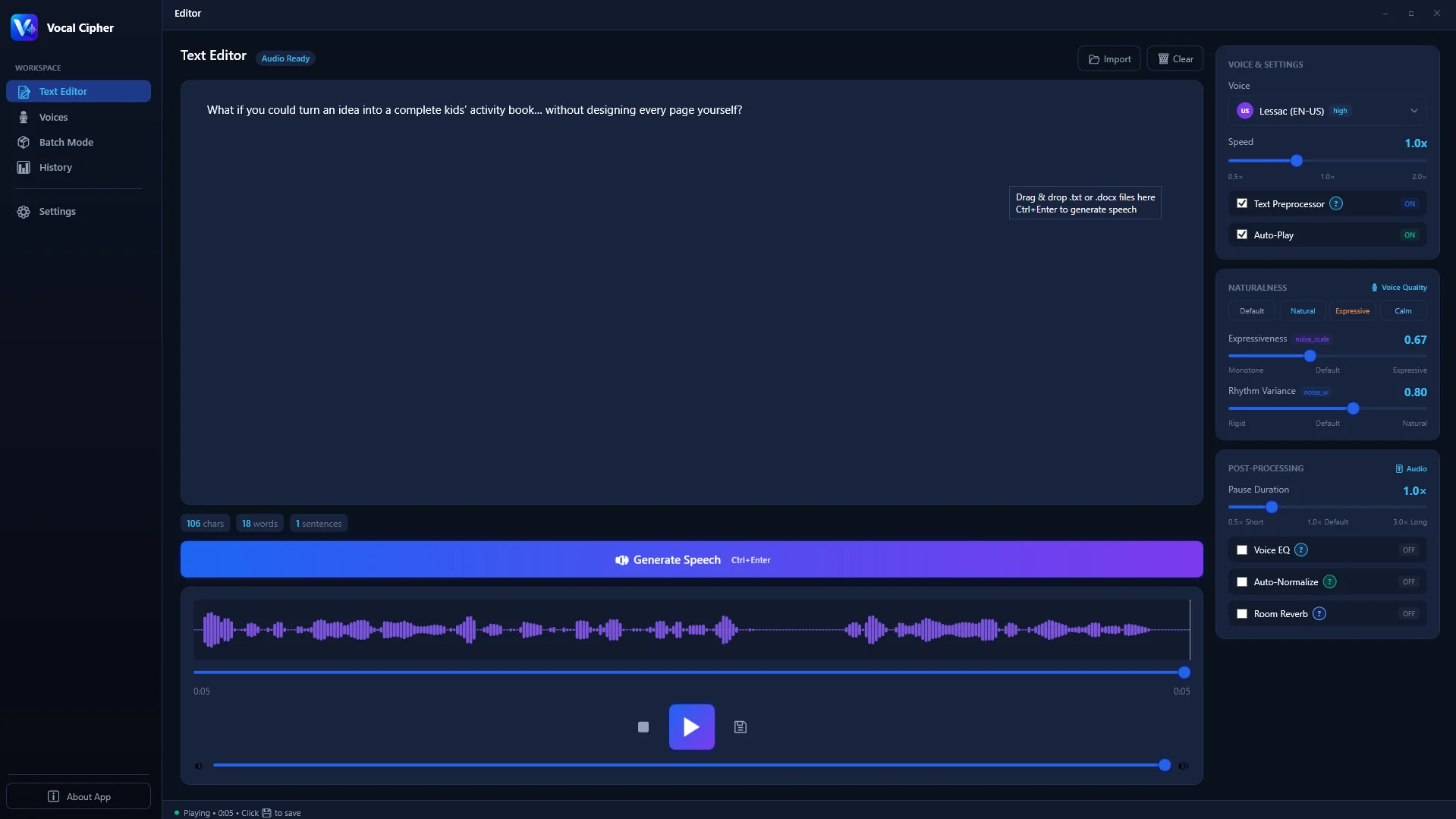
The Vocal Cipher text editor allows precise chapter chunking, pause insertion, and dialogue styling.
Manuscript Pre-Processing: Preparing E-Books for Flawless Synthesis
A raw manuscript formatted for print typography or Kindle e-readers contains dozens of layout artifacts that ruin spoken narration if pasted directly into a speech engine. Executing a clean pre-processing pass on your document is the foundation of audiobook quality.
1. Removing Print Layout Debris
Always strip the following elements before feeding text into the synthesis pipeline:
- Page Numbers and Running Headers: In PDF or DOCX files, headers like 'Chapter 4: The Whispering Woods - Page 112' will be read aloud by the AI if left uncleaned.
- Footnotes and Super-scripts: Convert relevant footnotes into inline parenthetical remarks or discard them entirely if they reference academic bibliographic entries.
- Visual Illustrations and Captions: Text such as 'Figure 3.2: Cross-section of turbine' disrupts narrative flow unless rewritten as descriptive spoken commentary.
- Hyperlinks and URLs: Change 'visit https://mysite.com/downloads' to 'visit our website download section'.
2. Normalizing Punctuation and Dialogue Breath Marks
Neural speech models treat punctuation as musical notation. A period indicates a pitch drop and a 400ms pause. A comma signals a mid-sentence respiratory breath of 150ms to 200ms. An exclamation point sharpens vocal attack and raises pitch inflection.
- Replace Ellipses with Measured Commas: Extended ellipses ('......') can create awkward hesitations in some neural engines. Replace erratic dots with clean commas or single ellipsis tags.
- Standardize Dialogue Quotes: Ensure curly smart quotes and straight quotation marks are uniform throughout the manuscript so the neural parser consistently recognizes character dialogue boundaries.
- Expand Numbers and Financial Units: Write '$2.5 million' as 'two point five million dollars' and '1984' as 'nineteen eighty-four' to guarantee uniform pronunciation across every chapter.
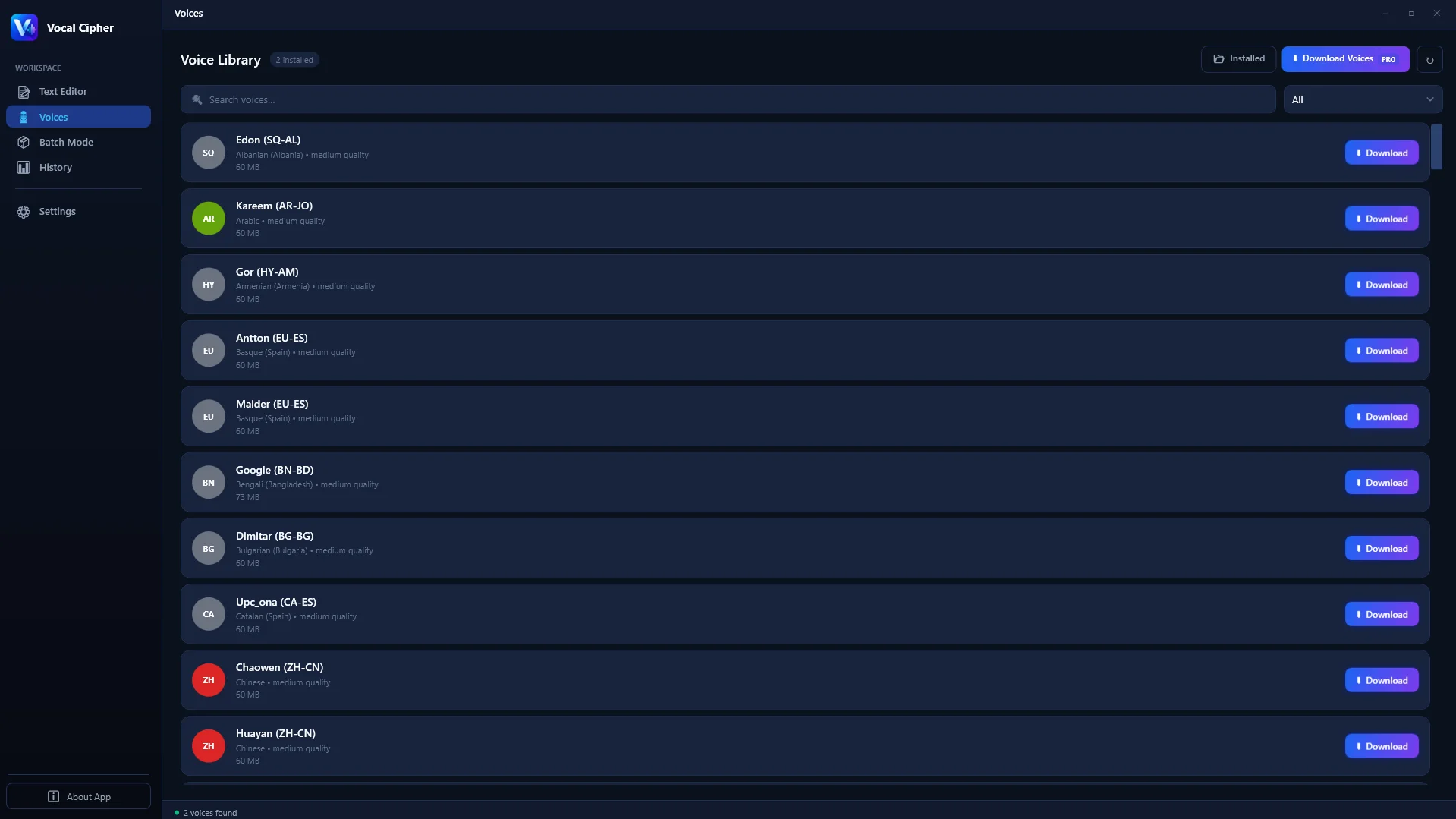
Choose from a diverse library of resonant fiction and non-fiction narrators with persistent voice seeds.
Maintaining Voice Consistency Across an 80,000-Word Manuscript
The biggest danger in automated audiobook synthesis is vocal drift. In uncalibrated cloud services, rendering Chapter 1 on Tuesday and Chapter 14 on Friday often results in subtle acoustic shifts in timbre, pitch baseline, or room reflection because the cloud platform updated its model weights or balanced server load across different cluster nodes.
To create an audiobook that listeners can enjoy for ten continuous hours without fatigue, the narrator's vocal timbre must remain mathematically identical from the introduction to the closing acknowledgments:
Vocal Cipher's Local Deterministic Synthesis Protocol
- Deterministic Model Weights: Because Vocal Cipher runs locally on your PC, the model binary on your NVMe SSD never changes between sessions. Chapter 22 rendered two months later sounds identical to Chapter 1.
- Fixed Voice Seed Parameter: Lock your primary narrator's voice seed. This locks the acoustic envelope, preventing random intonation variations from creeping into quiet exposition passages.
- Global Cadence Normalization: Set a master speech pace (e.g., 95% rate, corresponding to approximately 145 words per minute) that persists across all queued project documents.
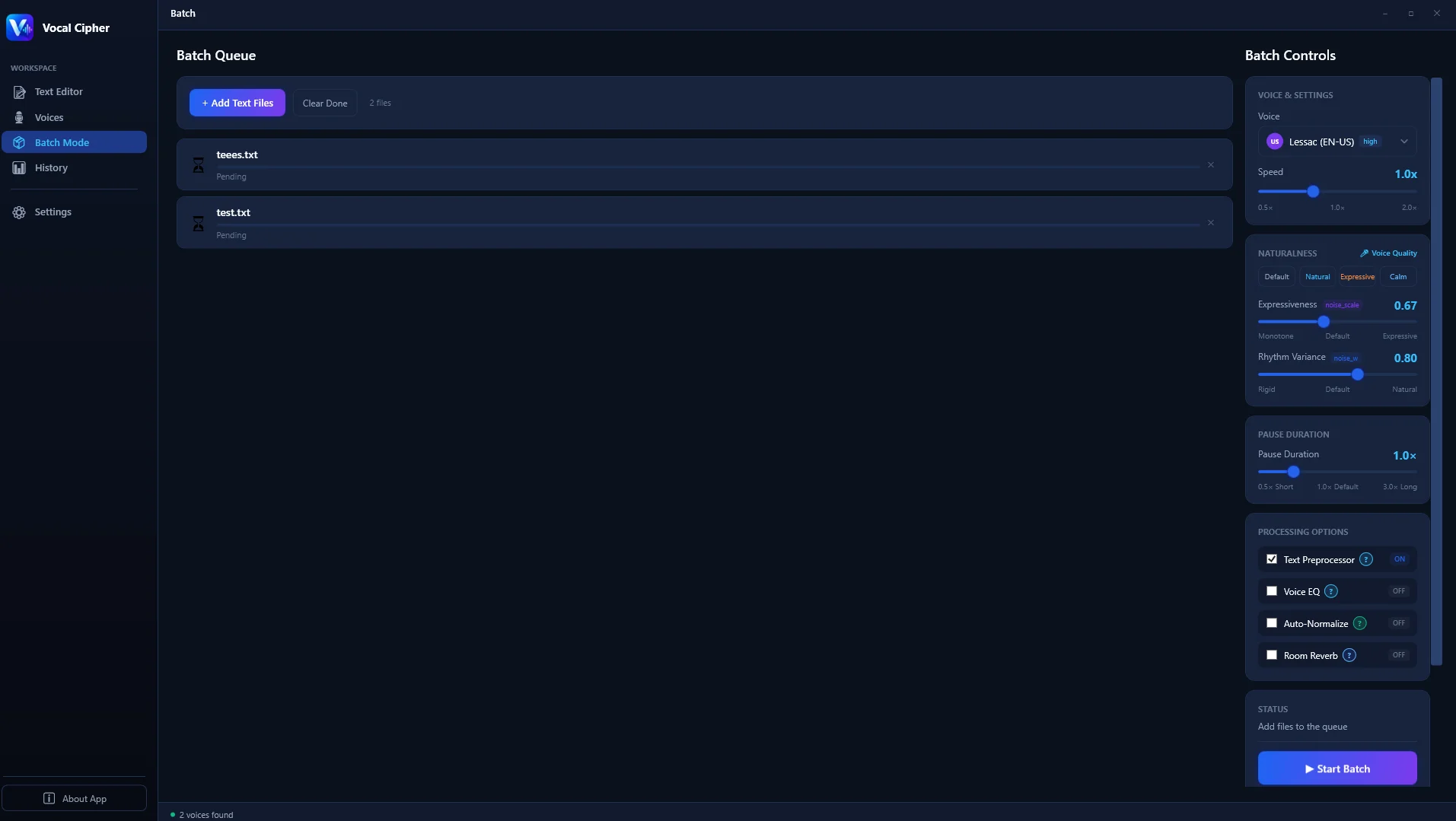
The batch queue ingests dozens of chapter documents and processes them sequentially at maximum local hardware speed.
Executing the Chapter Batch Synthesis Workflow
Instead of sitting at your computer copying and pasting small text fragments, professional audiobook publishers leverage Vocal Cipher's automated Batch Queue engine. Here is the exact production sequence:
Segment the Manuscript by Chapter
Save your edited manuscript into individual plain text (.txt) files inside a dedicated project folder. Name them logically according to ACX naming conventions: 00_Opening_Credits.txt, 01_Chapter_01.txt, 02_Chapter_02.txt, up to XX_Closing_Credits.txt.
Load Files into Vocal Cipher's Batch Queue
Drag and drop your chapter text files into the Vocal Cipher Batch Queue window. Select your designated audiobook narrator profile and configure output format to 24-bit 48kHz Linear PCM WAV.
Initiate High-Speed Local GPU Rendering
Click 'Start Batch'. Vocal Cipher utilizes TensorRT and CUDA acceleration on your local Windows graphics card. A standard 3,500-word chapter (approx. 24 minutes of audio) renders in roughly 60 to 90 seconds. You can render an entire 90,000-word novel while taking a lunch break.
Verify Generation History and Export Audio
Review your completed generation history list. You can listen to spot checks directly in the UI or export the organized audio files straight to your mastering directory.
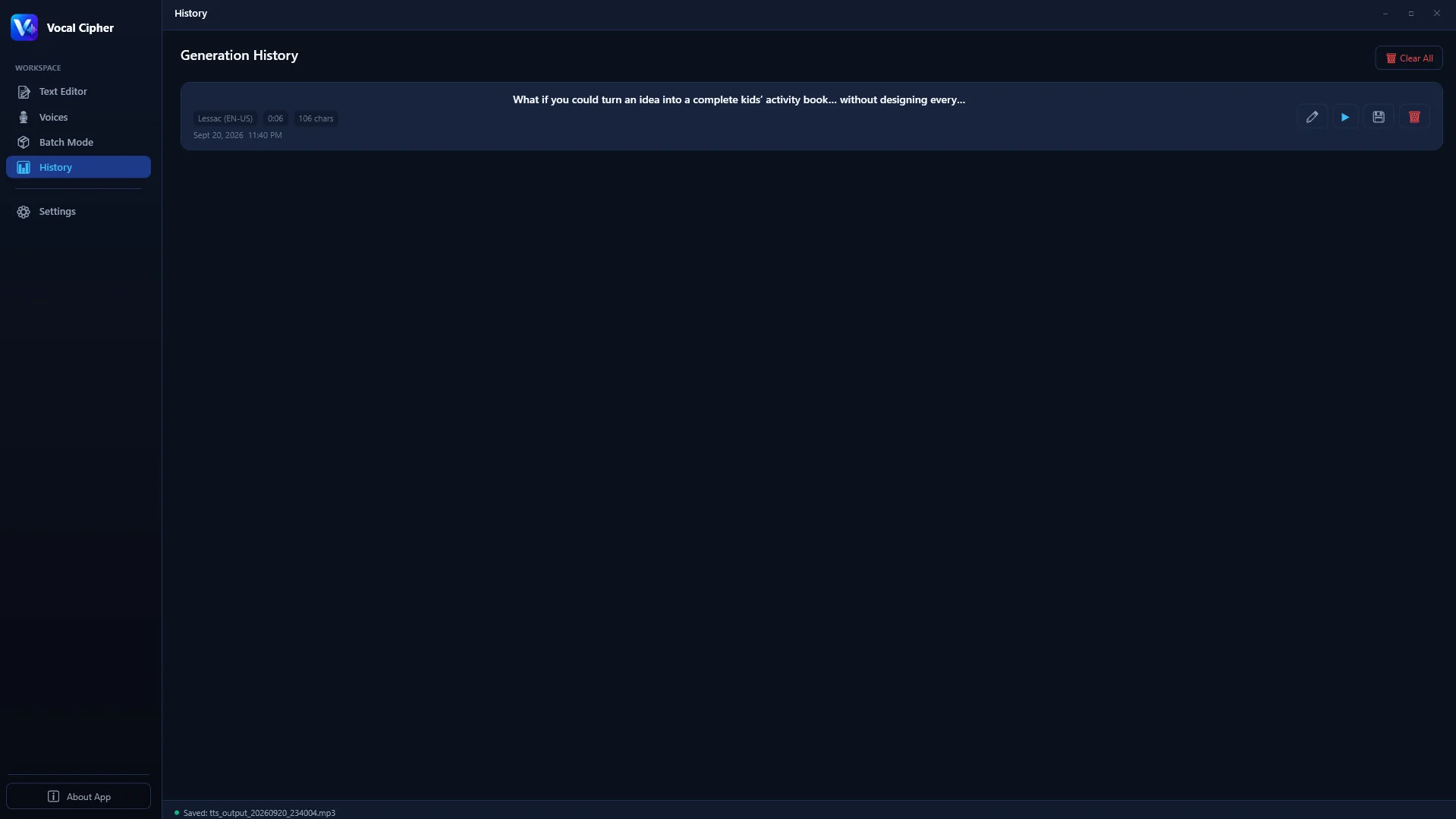
Instant playback and lossless WAV export for every chapter synthesized in the queue.
The 5-Step Mastering Chain for Guaranteed ACX Compliance
While Vocal Cipher exports pristine 24-bit audio stems, preparing them for final retail submission on Audible requires a brief post-synthesis mastering pass in Audacity, Reaper, or DaVinci Resolve Fairlight:
Audiobook Mastering Signal Chain
1. High-Pass Filter (Low-Cut at 70Hz, 18dB/octave)
Eliminates inaudible DC sub-bass rumble beneath human vocal cords. This clears up dynamic headroom and prevents low-frequency distortion in consumer earbuds.
2. Gentle Sibilance De-Esser (5.5kHz to 7.8kHz)
Attenuates harsh 's' and 't' transients by 2dB to 3.5dB. Listeners frequently consume audiobooks through in-ear headphones at elevated volume; taming sibilance prevents listener fatigue.
3. RMS Loudness Normalization (-20.5 dB RMS Target)
Target the exact midpoint of ACX's mandatory bracket (-23dB to -18dB RMS). Normalizing every chapter file to -20.5 dB RMS ensures a safe 2.5dB margin of error on either side.
4. True Peak Brickwall Limiting (-3.1 dBFS Ceiling)
Set a brickwall limiter ceiling to -3.1 dBFS. This guarantees that instantaneous peaks never cross ACX's -3.0 dBFS rejection threshold, even after lossy MP3 encoding.
5. Automated Head and Tail Room Tone Padding
Insert exactly 0.75 seconds of silence at the start of the audio file, and exactly 2.5 seconds of silence at the end. Export as 192 kbps Constant Bit Rate (CBR) stereo or mono MP3 at 44,100Hz.
Multi-Character Voicing in Fiction: The Dialogue Staging Technique
For fiction novels with colorful dialogue exchanges between multiple protagonists, relying on a single monotone voice delivery can feel flat. In traditional human narration, a skilled actor alters their pitch, cadence, and accent to embody different characters.
With Vocal Cipher, you can execute full-cast multi-character audio staging on your PC without spending thousands of dollars hiring multiple voice actors:
- Assign Persistent Character Profiles: Choose a warm, neutral narrator for the descriptive prose (e.g., 'Alistair'). Assign a distinct, gritty voice for the detective protagonist ('Marcus') and a light, fast-paced voice for the technical consultant ('Elena').
- Color-Coded Script Segmentation: Separate dialogue into distinct lines or export separate vocal stems for each character using the batch queue.
- Timeline Assembly in DAW: Import the synthesized dialogue clips into your DAW. Place the narrator on Track 1, Marcus on Track 2, and Elena on Track 3. Pan Marcus slightly 5% left and Elena 5% right to create a subtle, immersive stereo stage.
Handling Acronyms, Fantasy Names, and Foreign Words
Fantasy and science fiction manuscripts frequently feature invented character names, magical artifacts, or alien terminology ('Xylohar', 'Q'alath', 'Tel'perion'). In non-fiction and medical textbooks, complex pharmacological compounds ('acetylsalicylic acid') and industry acronyms ('SaaS', 'API', 'GUI') can trip up generic phoneme engines.
To ensure flawless pronunciation in Vocal Cipher, apply the Phonetic Replacement Pass:
- Spelled-Out Acronyms: If you want the engine to pronounce each individual letter, write them with hyphens:
A-P-IorN-A-S-A. If you want it pronounced as a single word, write it in lowercase:nasaorsaas. - Phonetic Transliteration: For invented fantasy names, write them out phonetically in your manuscript: replace 'Xylok' with 'Zye-lock', or 'Aethelred' with 'Eth-el-red'. The neural vocoder reads the phonetic spelling with pristine human naturalness.
- Global Search and Replace: Before generating your batch queue, run a quick search and replace across all chapter text files in Notepad++ or VS Code to apply your phonetic rules systematically across the entire book.
Long-Form Listening Fatigue: The Science of Natural Cadence
When someone listens to a 30-second TikTok voiceover, hyper-energetic robotic speech might pass without complaint. But an audiobook is an intimate, sustained experience that spans eight to fifteen hours. If the voice exhibits mechanical cadence, unnatural pitch leaps, or zero breath pauses, the human brain suffers cognitive listening fatigue within twenty minutes, prompting immediate customer returns and harsh 1-star reviews on Audible.
Vocal Cipher was engineered specifically to prevent listening fatigue across marathon sessions:
- Dynamic Sentence-Level Cadence: Rather than repeating identical melodic contours, Vocal Cipher's neural network examines full paragraph context to vary pitch inflections naturally, preventing monotonous chanting.
- Organic Micro-Pauses: Natural physiological breath pauses are automatically calculated based on syntactic clause structures, allowing listeners to comfortably absorb complex thoughts.
- Balanced Spectral Distribution: Vocal Cipher outputs smooth, warm low-mids without harsh high-frequency sizzle, ensuring the voice sounds soothing even when played through car speakers or premium noise-canceling headphones.
Audiobook Metadata, ID3 Tagging, and M4B Chapter Packaging
Audiobook listeners expect flawless metadata integration on mobile devices. When an Audible or Apple Books user starts Chapter 7, their car stereo or smartphone lock screen should display the precise chapter title, book title, author, narrator, and cover art.
Follow these standardized metadata protocols when exporting finished chapters:
- ID3v2.4 Tagging for MP3 Deliverables: Populate Title ('Chapter 01: The Journey Begins'), Artist / Author ('Jane Doe'), Album ('The Chrono Chronicles'), and Track Number (e.g., '1/24'). In the 'Composer' or 'Subtitle' field, add 'Narrated by Alistair (Vocal Cipher Voice System)' if desired.
- Cover Art Embedding: Embed a square 2400x2400 or 3000x3000 JPEG / PNG cover art file into every individual audio track. ACX mandates a minimum 2400x2400 pixel square resolution for retail catalog display.
- M4B Unified Audiobook Container: If distributing audiobooks directly to listeners through your own website, Shopify store, or Patreon, package your individual chapter WAV stems into a single, unified .m4b audiobook file containing embedded chapter markers, cover art, and resume bookmarks using open-source tools like ffmpeg or Audiobook Binder on PC.
Quality Control Checklist: Proof-Listening at 2.5x Speed with Synchronized Transcripts
Proof-listening an 85,000-word audiobook in real time requires nearly ten hours of continuous monitoring. Professional production houses accelerate this process dramatically by proof-listening at 2.0x to 2.5x speed while visually tracking the printed text:
- Phase 1: Dual Monitor Layout: Position your manuscript document on Monitor 1 and load your synthesized chapter audio files into an audio editor (such as Audacity, Reaper, or VLC Player) on Monitor 2.
- Phase 2: High-Speed Playback with Pitch Correction: Set playback speed to 2.2x with pitch preservation enabled. The human brain can easily detect mispronounced syllables, omitted words, or awkward pauses at this speed while reading along with the source manuscript.
- Phase 3: Timestamp Logging: Whenever an acoustic inconsistency occurs, pause playback and log the timecode and offending phrase in a simple text file: e.g., "Chapter 4, 14:22: Mispronounced 'chasm' as 'tchas-m' instead of 'kaz-m'".
- Phase 4: Targeted Punch-In Replacement: Launch Vocal Cipher, enter the corrected phrase phonetically ("The dark kaz-m yawned wide"), synthesize the 3-second segment, and paste it directly over the error in your DAW. Re-export the chapter in under thirty seconds without touching the rest of the file.
Retail Distribution Matrix: ACX vs. Findaway Voices vs. Kobo vs. Direct-to-Consumer
Once your audio master stems are finalized and verified against ACX technical guidelines, you have multiple profitable distribution avenues in 2026:
| Distribution Platform | Retail Ecosystem | Author Royalty Share | Pricing Control |
|---|---|---|---|
| ACX (Exclusive) | Audible, Amazon, Apple Books | 40% of net retail sales | Set by Audible algorithm |
| ACX (Non-Exclusive) | Audible, Amazon, Apple Books | 25% of net retail sales | Set by Audible algorithm |
| Findaway Voices (Spotify) | Spotify, Storytel, Chirp, 40+ outlets | 80% of net received | Author sets list price |
| Direct-to-Consumer (Shopify / Gumroad) | Your author website, BookFunnel app | 90% to 95% direct profit | 100% full pricing freedom |
Because producing an audiobook locally with Vocal Cipher carries zero ongoing production debt, you can freely distribute your audio across every global channel simultaneously, capturing high-margin direct sales while maintaining presence across major streaming catalogs.
Turn Your Manuscripts into Commercial Audiobooks
Stop paying thousands of dollars for studio sessions or burning character credits on cloud platforms. Produce unlimited ACX-ready audiobooks locally on your Windows PC.
Get Vocal CipherFrequently Asked Questions (FAQ)
Does Audible/ACX allow AI-generated voiceovers in 2026?
Yes. Audible and major audiobook distributors accept synthetic narration provided the content complies strictly with ACX acoustic quality benchmarks (RMS loudness, peak levels, noise floor, and chapter segmentation) and the publisher holds full commercial exploitation rights.
How long does it take to synthesize a 100,000-word book on a standard PC?
On a modern Windows desktop or laptop equipped with an NVIDIA RTX GPU, Vocal Cipher synthesizes speech at approximately 15x to 35x real-time speed. A 100,000-word book (about 11 finished audio hours) renders completely in roughly 20 to 40 minutes.
Are there any word limits or monthly character caps in Vocal Cipher?
No. Vocal Cipher runs entirely on your local PC hardware. There are zero character counts, zero monthly subscription tiers, and zero word limits. You can produce hundreds of full-length audiobooks with complete freedom.
Can I keep my unreleased manuscripts private and secure?
Yes. Because Vocal Cipher operates completely offline without connecting to cloud APIs, your manuscripts, character outlines, and proprietary audio files never leave your computer, safeguarding your unpublished intellectual property.
What is the recommended audio format for archiving finished audiobooks?
Always export and archive your master files in uncompressed 24-bit 48kHz Linear PCM WAV format. This preserves the absolute highest acoustic fidelity. You can then encode distribution copies to 192 kbps CBR MP3 for ACX and Audible upload.
Can I use different accents for different characters in a novel?
Yes. Vocal Cipher features a diverse library of regional accents, including American (General, Southern, New York), British (Received Pronunciation, London), Australian, and European variations, allowing you to cast distinct accents for every character.
Do I owe any royalties on audiobooks sold on Audible or Apple Books?
No. All audio created with Vocal Cipher is 100% royalty-exempt. You own all commercial distribution rights and retain all proceeds from your book sales across all distribution channels.
Can I re-generate a single sentence if an edit is made to the book?
Yes. If an author or editor revises a single phrase in Chapter 18, simply paste the revised sentence into the editor with the same voice profile. Vocal Cipher synthesizes the pickup phrase in two seconds, allowing you to drop it seamlessly into your timeline.
How does Vocal Cipher handle footnotes and academic citations in non-fiction audiobooks?
In traditional print books, footnotes disrupt the auditory flow if read aloud in the middle of sentences. In Vocal Cipher, authors can either convert critical footnotes into natural inline parenthetical remarks (e.g., 'as documented in historical research') or strip numerical citation markers automatically prior to queue synthesis, ensuring a seamless, pleasant listening journey for non-fiction audiences.
Can I export audiobooks directly with chapter markers into M4B containers?
Vocal Cipher exports pristine, uncompressed 24-bit 48kHz WAV chapter stems organized by file name. You can then quickly bundle these sequential files into a single master M4B container with embedded chapter titles, cover images, and playback bookmarks using open-source companion audio utilities on Windows like ffmpeg or Chapter and Verse before publishing to direct-to-consumer storefronts.