Creating deep, thunderous movie trailer and announcer voices with artificial intelligence on PC requires three core pillars: selecting an offline bass-baritone neural model that operates at a low fundamental frequency (between 65Hz and 110Hz), formatting scripts with deliberate cadence and 1.5-to-2.5-second dramatic pauses, and applying a broadcast post-production mastering chain that utilizes subharmonic synthesis, serial compression, and high-frequency air enhancement. By using Vocal Cipher locally on Windows, filmmakers, game developers, and video producers can synthesize uncompressed 24-bit 48kHz cinematic narration stems without recurring monthly cloud subscriptions or token caps.
The Golden Rule of Cinematic Trailer Narration in 2026
A movie trailer voice is defined as much by its silence as by its sound. Fast, conversational speech instantly dissolves cinematic tension. True blockbuster narration demands an unhurried, measured pace (95 to 115 words per minute), allowing massive orchestral brass swells, sub-bass impacts, and visual CGI explosions to occupy the acoustic space between vocal declarations.
The Heritage of the 'Voice of God': From Don LaFontaine to Desktop Neural Synthesis
For over four decades, Hollywood movie trailers were defined by a select cadre of legendary voiceover artists. Iconic performers like Don LaFontaine (the voice behind more than 5,000 movie trailers), Hal Douglas, and Ernie Anderson established the classic cinematic vocal aesthetic: an authoritative, deep baritone that commanded immediate reverence and made every low-budget indie thriller sound like a $200 million summer blockbuster.
Traditionally, achieving this sound required hiring elite union voice talent at rates exceeding $1,500 to $3,500 per trailer read, booking specialized commercial recording studios equipped with legendary Neumann U87 or Sennheiser MKH 416 microphones, and running hardware Avalon or Manley tube preamplifiers.
While cloud voice services introduced basic synthetic narration, they historically failed at movie trailers. Cloud models trained on conversational podcasts sounded thin, tinny, and devoid of chest resonance. Furthermore, cloud compression algorithms (streaming lossy 128kbps MP3s) discarded the critical sub-100Hz frequency information that gives cinema voiceovers their physical, room-shaking weight.
In 2026, desktop neural synthesis engines like Vocal Cipher have rewritten the rules. By rendering deep neural speech models locally on Windows as uncompressed 24-bit 48,000Hz Linear PCM WAV stems, creators capture the full acoustic bandwidth, sub-bass harmonics, and commanding dynamic headroom of an authentic Hollywood recording session.

Vocal Cipher: Thunderous Trailer Voice Synthesis
Produce earth-shaking movie trailer narration and broadcast announcer stems directly on your Windows PC. Enjoy unlimited local generation, deep baritone personas, and uncompressed 24-bit audio exports with a single perpetual license.
Get Vocal CipherThe Acoustic Physics of the Deep Movie Trailer Voice
What gives a movie trailer voice its visceral authority? The human perception of power in spoken dialogue is governed by four distinct acoustic phenomena:

Select deep bass-baritone and authoritative announcer profiles inside Vocal Cipher.
The Four Acoustic Pillars of Trailer Vocals
1. Fundamental Frequency (F0: 65Hz to 105Hz)
The fundamental frequency of a true cinematic trailer voice sits in the low bass register. A standard male conversational voice vibrates around 125Hz. A trailer announcer operates an octave lower, resonating between 65Hz (C2) and 100Hz (G2). This ultra-low fundamental activates the physical tactile sensation of bass in movie theaters and home surround sound subwoofers.
2. Chest Cavity Formant Tuning (180Hz to 320Hz)
The second formant region (F1/F2 boundary) governs perceived chest size. Lowering formants simulates an anatomical rib cage and thoracic cavity of immense volume. This imparts a solid, woody resonance that makes the speaker sound physically imposing.
3. Simulated Proximity Effect
In directional cardioid and figure-8 microphones, speaking within two inches of the capsule causes a steep acoustic bass boost below 200Hz. This proximity effect creates an intimate, larger-than-life presence where the announcer sounds like they are whispering directly into the listener's ear canal with immense acoustic authority.
4. Extended High-Frequency Air Band (10kHz to 16kHz)
Paradoxically, a great deep voice is not just about low bass; it requires crystalline high-frequency air. Without high-end harmonic sparkle, deep voices sound like muffled mud. Uncompressed 24-bit 48kHz WAV audio preserves the delicate consonant friction of syllables like "s", "t", and "k", ensuring 100% speech intelligibility even over roaring trailer music.
Scripting Secrets for Blockbuster Movie Trailers
Writing for movie trailers is fundamentally different from writing screenplays or YouTube video essays. Trailer dialogue consists of sparse, monumental declarations designed to establish high stakes in three seconds:
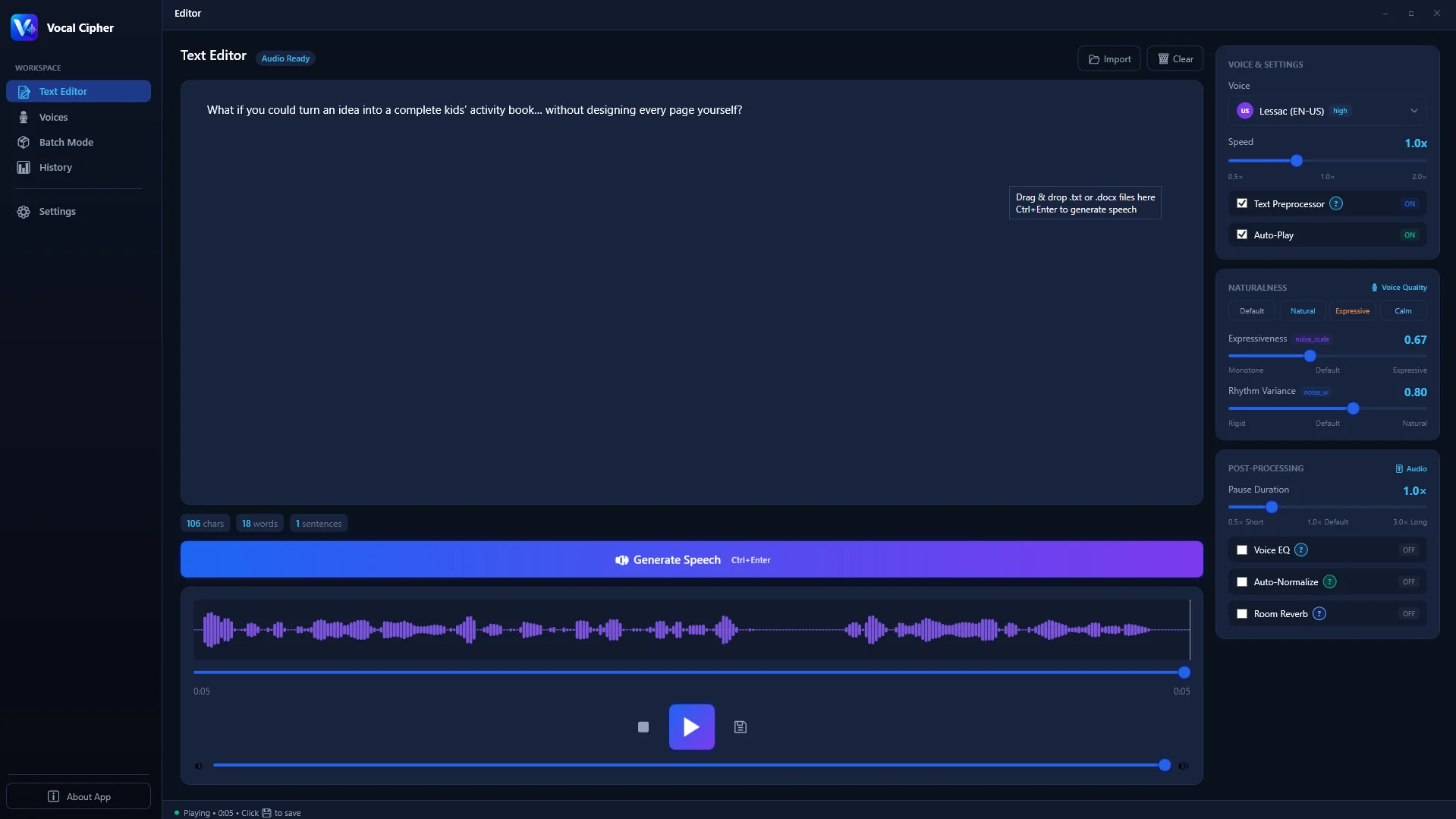
Draft dramatic trailer one-liners and control pause durations directly inside Vocal Cipher.
- The Rule of Three Declarations: Classic trailers build in three escalations. Phrase 1 establishes the baseline reality ("For a thousand years, peace reigned."). Phrase 2 introduces the catastrophic fracture ("Until the sky fell silent."). Phrase 3 issues the ultimatum ("Now, our survival rests in the hands... of one man.").
- Punctuation as Acoustic Airbrakes: Never write long compound sentences. Use colons and ellipses to force the neural speech engine to pause for breath, creating room for cinematic sound effects (e.g., "His mission was simple: survive.").
- Phonetic Capitalization on Title Cards: When announcing titles, spell words with capitalized letters separated by hyphens to force deep, separated enunciation (e.g., "D-A-R-K-N-E-S-S R-I-S-I-N-G").
- Spelled-Out Release Dates: Never write "11/24/26" or "Coming Nov 2026." Write "This November. Only in theaters." Short, declarative sentence fragments hit the listener's brain with maximum retention.
The Hollywood Trailer Audio Mastering Chain (Step-by-Step)
Once you have exported your dry, uncompressed 24-bit 48kHz trailer stems from Vocal Cipher, route them through this industry-standard five-plugin mastering chain in your DAW (Reaper, DaVinci Resolve Fairlight, Pro Tools, or Premiere Pro):
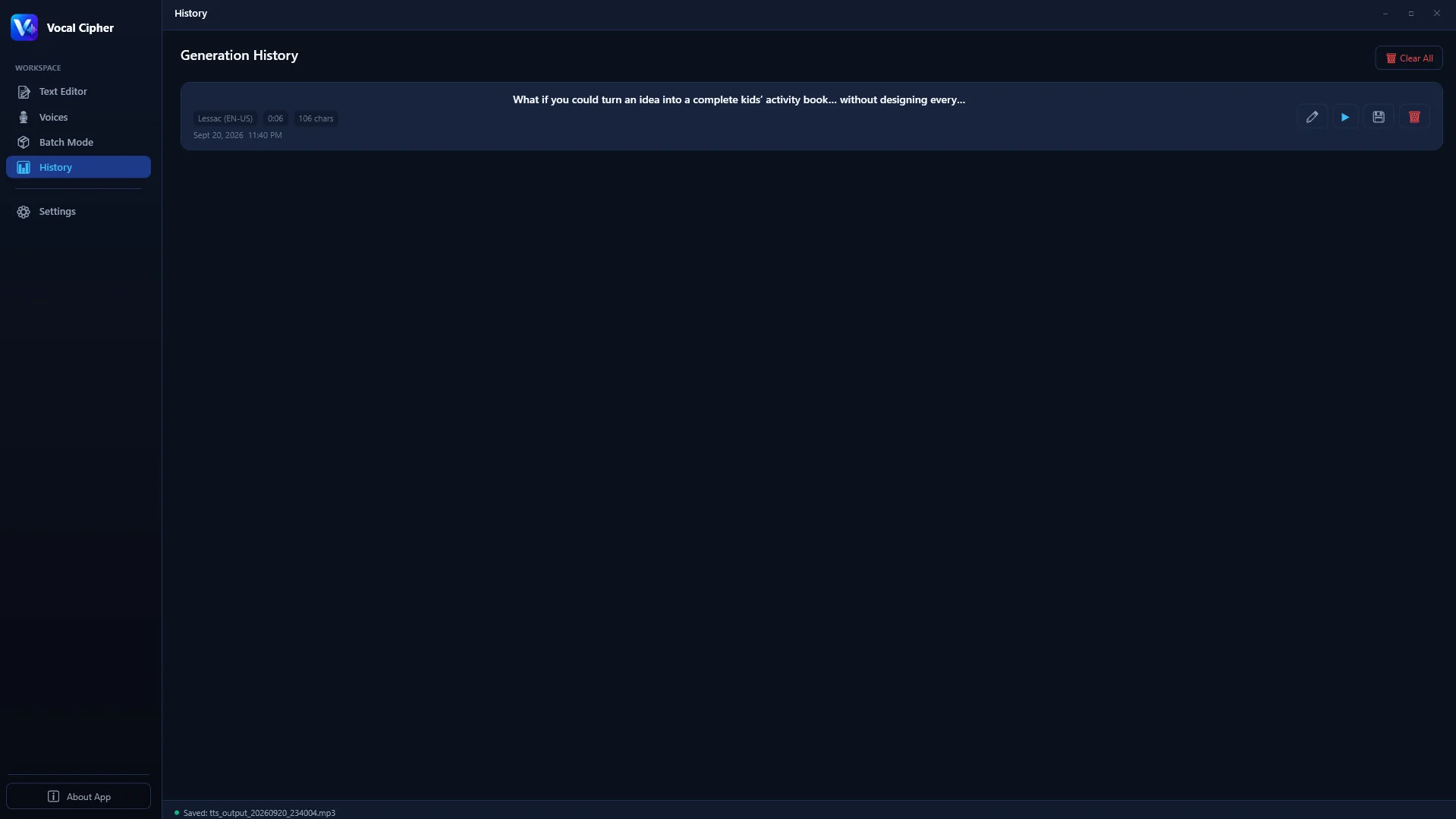
Export uncompressed 24-bit 48kHz WAV audio files with zero compression smear.
The 5-Stage Cinematic Vocal Mastering Chain
1. High-Pass Filter with Resonance Bump (55Hz)
Insert an equalizer and set an 18dB/octave high-pass filter at 55Hz. Sub-audible room thumps below 50Hz steal amplifier headroom. Add a gentle +1.5dB resonance bump at 65Hz to 75Hz to accentuate the chest fundamental frequency.
2. Subharmonic Synthesizer (e.g., Waves Submarine, DBX 120A)
Route audio through a subharmonic generator tuned to the 40Hz to 60Hz band. Set the wet mix to a conservative 12% to 15%. This generates synthesized sub-bass harmonics one octave below the voice fundamental, giving dialogue a visceral rumble that rattles cinema subwoofers without sounding artificial.
3. Serial Dual-Stage Compression (FET + Optical)
Trailer dialogue demands intense dynamic control. First, insert a fast FET compressor (1176 style) with a 4:1 ratio, fast attack (20 microseconds), and fast release (50ms) to shave off sharp 3dB transient peaks. Follow immediately with a smooth optical compressor (LA-2A style) for 4dB of slow, musical gain leveling. This serial combination produces an impenetrable, upfront wall of vocal authority.
4. Analog Tape Saturation (e.g., UAD Studer A800, Soundtoys Decapitator)
Drive a virtual 15 IPS magnetic tape machine plugin with moderate input gain. Analog tape naturally compresses low-frequency transients and adds pleasant second and third-order harmonic overtones, making the synthetic baritone sound thick, warm, and vintage.
5. True Peak Limiting (-1.0 dBTP)
Set a brickwall limiter ceiling to -1.0 dBTP (True Peak). This prevents inter-sample clipping when your trailer mix is transcoded by YouTube, Netflix, or cinema projection servers.
Multi-Track Trailer Mixing: Carving Space Around Braams and Risers
A major challenge in movie trailer post-production is preventing the deep voiceover from colliding with massive cinematic sound design elements, particularly trailer braams (that iconic low-frequency foghorn sound popularized by Inception) and sub-bass impact booms.
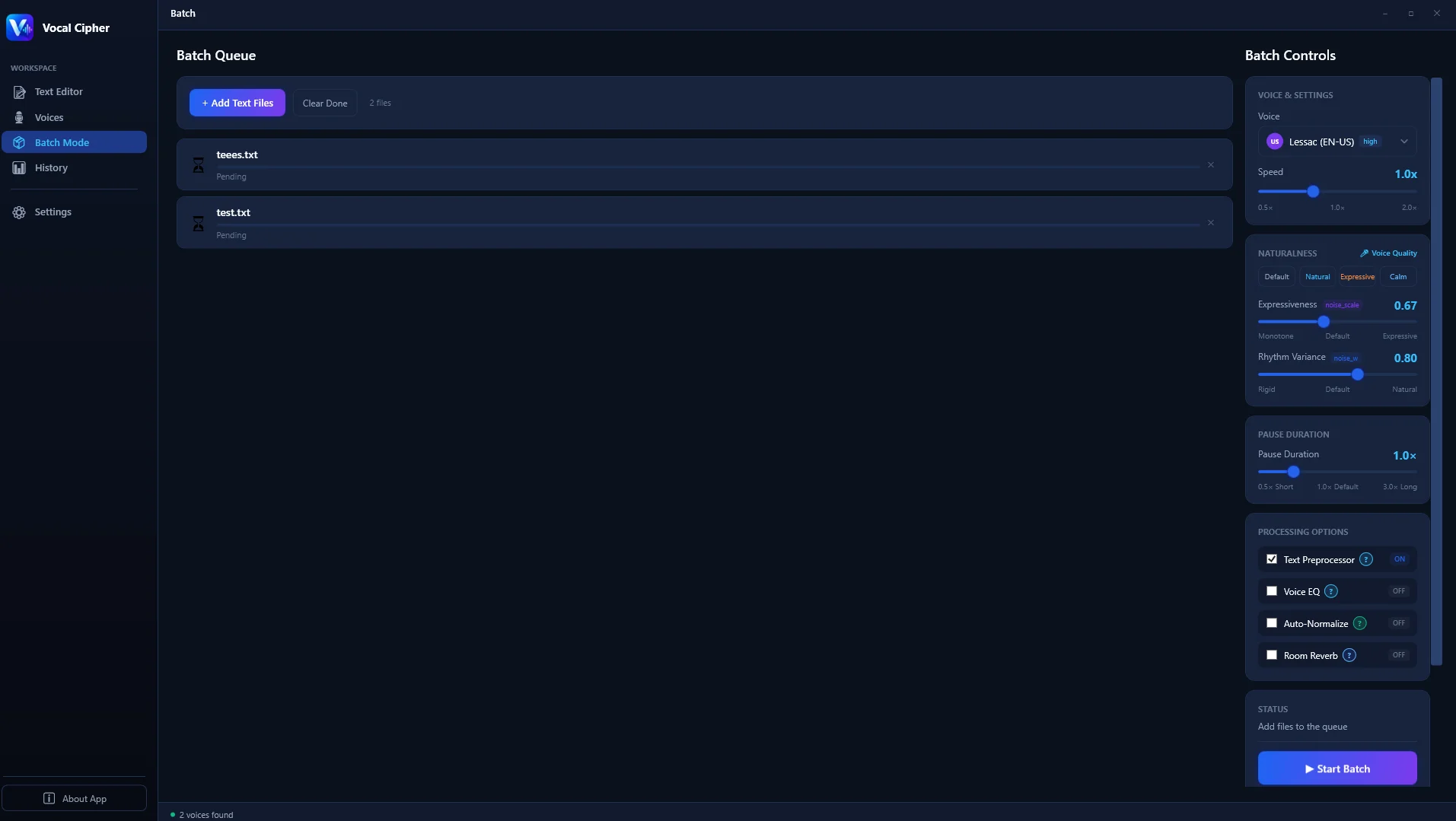
Process trailer acts as independent audio stems in the batch queue to streamline multi-track timeline alignment.
Follow these three rules when mixing trailer narration:
- Sidechain Notch on Trailer Braams: When a massive brass hit sounds simultaneously with the voiceover, insert a dynamic EQ on the braam track keyed to the voice. Notch out 3.5dB at 250Hz. This preserves the voice's chest clarity while allowing the braam to shake the room.
- The Staggered Hit Protocol: Whenever possible, never place a major sound design impact directly on top of a word. Drop the impact hit 12 to 16 frames after the announcer finishes speaking the phrase. The sequence should be: Announcement -> Dramatic Visual Cut -> Heavy Impact Boom -> Silence.
- Mono Centering for Absolute Dialogue Punch: Keep the voiceover 100% mono down the center channel. In surround 5.1 and 7.1 mixes, route narration strictly to the Center (C) channel, sending zero vocal energy to the Left and Right mains. This locks dialogue position regardless of where the movie theater attendee sits.
Comprehensive Comparison: Cloud AI vs. Union Voice Talent vs. Local Synthesis
Review the comparative economics of movie trailer voiceover production in 2026:
| Production Factor | Union Trailer Talent | Cloud AI Voice APIs | Vocal Cipher (Local PC) |
|---|---|---|---|
| Pricing Structure | $1,500 to $5,000+ per trailer read | $20 to $120/mo + character overages | Single one-time desktop license |
| Sub-Bass Fidelity | Pristine (Live Studio Mic) | Compressed MP3 (Loss of sub-80Hz) | Uncompressed 24-bit 48kHz WAV |
| Turnaround Time | 24 to 72 hours per revision | Instant, but queue-dependent | Instant local render (10x-35x speed) |
| Project Confidentiality | Requires strict NDAs | Transmitted to third-party cloud servers | 100% offline and air-gapped on your PC |
| Commercial Royalties | Recurring broadcast residuals | Varies by platform subscription tier | Zero royalty obligations |
Managing Crest Factor: Why Hollywood Narration Cuts Through Orchestral Swells
In audio engineering, the crest factor is the mathematical ratio between the highest instantaneous peak amplitude of an audio waveform and its continuous Root Mean Square (RMS) energy. Unprocessed live microphone recordings and raw synthetic voice outputs typically have a high crest factor of 14dB to 18dB. That means short transient consonants (like the click of a 't' or 'k') spike near 0dBFS, while the sustained chest resonance of the vowels sits much lower at -16dBFS.
When you place high crest-factor dialogue into an intense trailer mix alongside thundering timpani, French horn fanfares, and massive synth sub-booms, the vowels are immediately drowned out. If you raise the track volume, the transient peaks clip the master bus.
Hollywood trailer mixers solve this by applying crest factor reduction:
- Soft Clipping the Peaks: Insert an analog-modeled soft clipper (such as Kazrog KClip or StandardCLIP) to gently shave off the top 2dB of transient spikes without generating audible distortion.
- Parallel 'New York' Compression: Send a clean copy of your 24-bit Vocal Cipher voice stem to an auxiliary track. On the aux track, apply extreme compression (20:1 ratio with fast attack and fast release, driving 10dB of continuous gain reduction). Blend this dense, compressed parallel signal at -12dB beneath the dry voiceover. This brings up the subtle trailing breath and chest rumble, lowering the crest factor to a tight, impenetrable 8dB.
Cinematic Vocal Presets by Film Genre
Different film genres require tailored vocal textures. Inside Vocal Cipher, you can sculpt distinct aesthetic personas for every cinema genre:
Genre-Specific Cinematic Vocal Blueprints
1. Sci-Fi and Cyberpunk Blockbusters
Acoustic Formula: Deep, measured baritone with neutral emotional inflection. Pacing: 105 WPM. In post-production, add a short digital room impulse response with an early reflection delay of 35ms and a subtle flanger at 0.2Hz to simulate an omniscient interstellar artificial intelligence.
2. Psychological Horror and Supernatural Thrillers
Acoustic Formula: Intimate close-mic proximity delivery with prominent vocal fry and breathiness. Fundamental pitch set to 80Hz. Post-production: Pan the dry vocal center, but apply an asymmetrical pitch-detuned stereo delay (+7 cents on the left, -9 cents on the right) blended at -18dB. This psychoacoustically disorients the listener, creating an eerie sense of dread.
3. Epic High Fantasy and Historical Sagas
Acoustic Formula: Resonant, authoritative chest timbre with slight British RP (Received Pronunciation) or Mid-Atlantic cadence. Pacing: Slow 95 to 105 WPM. Add a large stone hall convolution reverb blended at -20dB with a 45ms pre-delay to maintain crisp consonant clarity before the grand acoustic reflections bloom.
4. Summer Action & Superhero Blockbusters
Acoustic Formula: Aggressive mid-range punch with heavy consonantal attack. Pacing: 115 WPM. Boost 3.2kHz by +2.5dB with a wide Q curve and saturate through a virtual Neve 1073 preamp plugin to make every declaration slice cleanly through explosive gunfire and roaring sound effects.
The 8-Layer Trailer Acoustic Sound Bed Architecture
To achieve that earth-shattering theater impact, Hollywood sound designers arrange trailer audio across eight structured timeline tracks in their NLE or DAW:
- Track 1 (VO_CENTER): The dry, 24-bit 48kHz master dialogue stem generated by Vocal Cipher. Centered mono, processed with serial compression and limiter.
- Track 2 (VO_SUB_HARMONIC): The subharmonic octave-down reinforcement channel (40Hz to 60Hz), active only during dialogue phrases to shake subwoofers.
- Track 3 (SFX_BRAAMS): Massive brass synth blasts, dynamically sidechained to duck 3dB when Track 1 speaks.
- Track 4 (SFX_IMPACTS): Sub-bass booms, metal slams, and cinema anvil hits positioned on visual cut points.
- Track 5 (SFX_RISERS): Pitch risers and white noise sweeps that build tension during vocal pauses.
- Track 6 (SFX_WHOOSHES): Fast stereo pass-bys that carry the eye into the next scene transition.
- Track 7 (MX_ORCHESTRAL): The hybrid orchestral score (horns, strings, percussion), notched at 250Hz and 3.5kHz.
- Track 8 (AMB_DRONE): Low-frequency tonal drone that anchors the entire trailer in an ominous mood.
Multi-Pass Campaign Batching: Teaser, TV Spot, and Official Trailer
Commercial film marketing campaigns require multiple promotional edits across different media formats:
- The 30-Second Social Teaser (Vertical 9:16): Hyper-focused hook and title reveal. Needs rapid 120 WPM pacing and heavy compression for mobile smartphone speakers.
- The 60-Second Broadcast TV Spot (16:9): Balanced narrative arc calibrated to broadcast television loudness (-24 LKFS / -23 LUFS).
- The 2.5-Minute Official Theatrical Trailer: Complete three-act orchestral structure with maximum dynamic range (LRA 12 LU) for cinema surround systems.
Using Vocal Cipher's batch queue, you can load scripts for all three campaign deliverables simultaneously. The local Windows engine synthesizes every script variation in under thirty seconds, outputting organized stems to your project folder with zero per-word fees.
The Psychoacoustics of Vocal Authority: Why Low Frequencies Trigger Cinematic Gravitas
Human evolutionary biology plays a decisive role in why audiences react so viscerally to deep trailer narration. Low fundamental frequencies (F0) ranging between 75Hz and 110Hz are subconsciously processed by the human brain as indicators of physical scale, evolutionary authority, and immediate impending danger. When an audience sits in an acoustically treated cinema, acoustic energy in the 80Hz to 120Hz zone resonates through the human chest cavity via bone conduction and sympathetic somatic resonance.
However, deep pitch alone is insufficient to convey genuine authority. In synthetic speech synthesis, simply pitching down a standard voice profile without maintaining harmonic formants results in the infamous 'chipmunk downpitch' artifact, where the vocal tract sounds artificially elongated, sluggish, and robotic. Vocal Cipher avoids this acoustic defect through advanced neural formant scaling. When you adjust the pitch and resonance parameters inside the software, the neural voice model preserves the exact biological characteristics of human vocal cords:
- Laryngeal Cavity Preservation: The physical dimensions of the simulated throat tract scale naturally, preventing synthetic resonance distortion.
- Consonant Friction Crispness: High-frequency sibilance ('s', 'sh', 'ch') and transient plosives ('p', 't', 'b') remain untangled at 4kHz to 7kHz, guaranteeing perfect textual intelligibility even as the vowel fundamentals shake the subwoofer.
- Subharmonic Overtones: Rich acoustic warmth is infused naturally across the first three vocal harmonics (160Hz, 240Hz, and 320Hz), creating that signature creamy chest resonance heard in premium documentary and theatrical campaigns.
Step-by-Step Practical Tutorial: Crafting a High-Stakes Sci-Fi Action Trailer Voiceover in 5 Minutes
To understand how rapidly you can produce cinema-grade trailer assets locally, follow this practical 5-minute production walkthrough inside Vocal Cipher:
- Step 1: Paste Your Dramatic Script: Launch Vocal Cipher on your Windows workstation. Paste your trailer lines into the text editor. Break your script into three distinct lines with generous punctuation (commas, ellipses, and periods) to establish dramatic cinematic cadence: "At the edge of the galaxy... humanity made a promise. But out here... promises bleed."
- Step 2: Select an Authoritative Baritone Model: Open the Voice Library selector. Filter by 'Narrator / Deep Tone' and pick an authoritative baritone persona. Test a two-second audition phrase to confirm the baseline vocal timbre matches your project aesthetic.
- Step 3: Dial in Pacing and Micro-Pauses: Reduce the global speech pace slider to 90% (roughly 105 words per minute). Insert a 1.2-second pause tag immediately before the final climactic sentence to create unbearable dramatic suspense.
- Step 4: Execute Instant Neural Synthesis: Click 'Synthesize'. Your local graphics card processes the neural speech tokens in less than 3 seconds without transmitting a single byte across the internet.
- Step 5: Export Lossless 24-Bit WAV: Choose 'Export Audio' and select Linear PCM WAV at 24-bit 48kHz. Drop the uncompressed audio stem directly onto track 1 of your timeline in DaVinci Resolve or Premiere Pro, ready for multi-track sound design layering.
Command Blockbuster Authority on PC
Stop settling for thin, compressed cloud voiceovers. Generate earth-shaking movie trailer and announcer vocals with uncompressed 24-bit audio directly on Windows.
Get Vocal CipherFrequently Asked Questions (FAQ)
Can Vocal Cipher generate both action trailer and documentary announcer voices?
Yes. Vocal Cipher includes a wide range of low-register voices spanning gritty action hero trailers, dramatic documentary narration, prestigious museum audio guides, and authoritative commercial announcers.
How can I make the AI voice sound even deeper without creating distortion?
Inside Vocal Cipher, lower the base pitch by -1.5 to -2.5 semitones. In your DAW, use a subharmonic synthesizer (adding 50Hz to 60Hz energy at 10% to 15% mix) rather than cranking a graphic equalizer bass slider, which introduces muddy phase distortion.
Can I use these voiceovers for commercial theatrical film releases and broadcast television?
Yes. All stems exported from Vocal Cipher carry zero royalty obligations. You retain complete ownership of the audio files and can exploit them commercially in cinema trailers, television broadcasts, video games, and online advertising.
Why do cloud voiceover APIs sound thin on deep trailer narrations?
Cloud services prioritize web streaming bandwidth and use lossy MP3 or Opus compression. These codecs discard low-frequency phase coherence and roll off sub-bass information below 80Hz. Uncompressed 24-bit Linear PCM WAV generated locally in Vocal Cipher preserves the entire acoustic spectrum.
What is the ideal speaking pace for movie trailers?
Movie trailer pacing is slow and deliberate, typically between 95 and 115 words per minute. This allows dramatic music hits, risers, and sound effects to hit with maximum impact during the silence between spoken lines.
Can I keep unreleased movie scripts private when synthesizing voiceovers?
Yes. Vocal Cipher runs 100% locally and offline on your Windows workstation. No scripts, voice files, or project metadata are ever uploaded to cloud servers, ensuring strict NDA and copyright protection for unreleased films.
How does Vocal Cipher handle multi-track surround sound mixing (5.1 and 7.1)?
Vocal Cipher exports uncompressed mono 24-bit WAV stems at 48,000Hz, which is the universal standard for dialogue routing in surround sound NLEs. You can assign the stem directly to the Center (C) channel in DaVinci Resolve Fairlight, Premiere Pro, or Pro Tools.
Can I create custom voice profiles for recurring podcast or YouTube channel intros?
Yes. Once you dial in the exact combination of bass depth, speech rate, and intonation for your channel's announcer persona, you can save it as a permanent preset in Vocal Cipher to ensure brand consistency across all future episodes.