Making AI voices sound truly human in 2026 requires understanding stress-timed prosody: structuring written scripts with intentional punctuation marks that command micro-pauses, phonetic respelling to resolve ambiguous homographs, and subtle dynamic pacing modulation between narrative acts. By executing neural speech synthesis locally on your PC through Vocal Cipher, creators manipulate acoustic inflections directly, eliminating the mechanical monotony of standard cloud text-to-speech without incurring recurring subscription fees or API character meters.
The Core Principle of Vocal Authenticity in 2026
Human speech is never metronomically consistent. Human speakers constantly accelerate through subordinate clauses, linger on poignant adjectives, drop pitch at the conclusion of ideas, and take subtle micro-breaths before significant declarations. The instant synthetic speech maintains an identical syllable duration across twenty consecutive words, the human brain detects artificiality. True realism comes from rhythmic asymmetry and intentional acoustic punctuation.
The Uncanny Valley of Synthetic Voiceovers: Why Traditional TTS Fails
For decades, text-to-speech systems were engineered primarily for utility: reading screen text for accessibility or reciting driving directions on navigation devices. These legacy systems operated on concatenative or basic parametric synthesis, stringing together pre-recorded phoneme snippets. The result was speech characterized by robotic pitch plateaus, unnatural consonant clicks, and an eerie lack of vocal emotion.
While modern neural networks have solved basic intelligibility, many cloud-based voice platforms still trigger the psychological "uncanny valley." When a listener hears an AI voice that sounds 90% human but maintains an unnatural, unvarying cadence, subconscious alarm bells ring. The listener focuses on the artificiality of the narration rather than the content of the message.
To escape this uncanny valley, creators must master three acoustic components:
- Prosodic Micro-Modulation: Subtle, continuous variations in fundamental pitch (F0) that prevent robotic drone.
- Stress-Timed Rhythmic Compression: Shortening auxiliary words (e.g., "to the", "in a", "of our") while emphasizing core thematic nouns and verbs.
- Pre-Phonation and Glottal Decay: Simulating the acoustic onset of vocal cords meeting airflow and the natural drop in amplitude at sentence conclusions.

Vocal Cipher: Nuanced Desktop Speech Synthesis
Ditch robotic cloud narrators and tedious XML tags. Vocal Cipher interprets organic text punctuation directly, giving you complete expressive control and lossless 24-bit audio on Windows with a single permanent license.
Get Vocal CipherLinguistic Mechanics: Stress-Timed vs. Syllable-Timed Prosody
One of the most profound breakthroughs in modern voice synthesis is understanding language rhythm classification. World languages generally fall into two broad timing categories:
- Syllable-Timed Languages (e.g., Spanish, French, Italian): Each syllable receives roughly equal time duration. It sounds rhythmic, machine-like, and metronomic by nature.
- Stress-Timed Languages (e.g., English, German, Russian): The time interval between stressed syllables is approximately equal, regardless of how many unstressed syllables are packed in between.
Consider this English sentence: "DOGS CHASE CATS." It contains three words, three syllables, and takes roughly one second to say. Now consider: "The DOGS will be CHASING the CATS." It contains eight syllables, yet a native English speaker delivers it in almost the exact same one-second window! The unstressed words ("The", "will be", "the") are squished and reduced in vowel duration.
When an AI speech engine treats every English syllable with equal length, it immediately sounds unnatural. In Vocal Cipher, the local neural model implements deep stress-timed acoustic modeling, naturally accelerating unstressed function words and lingering on emphasized nouns to mimic human conversational flow.
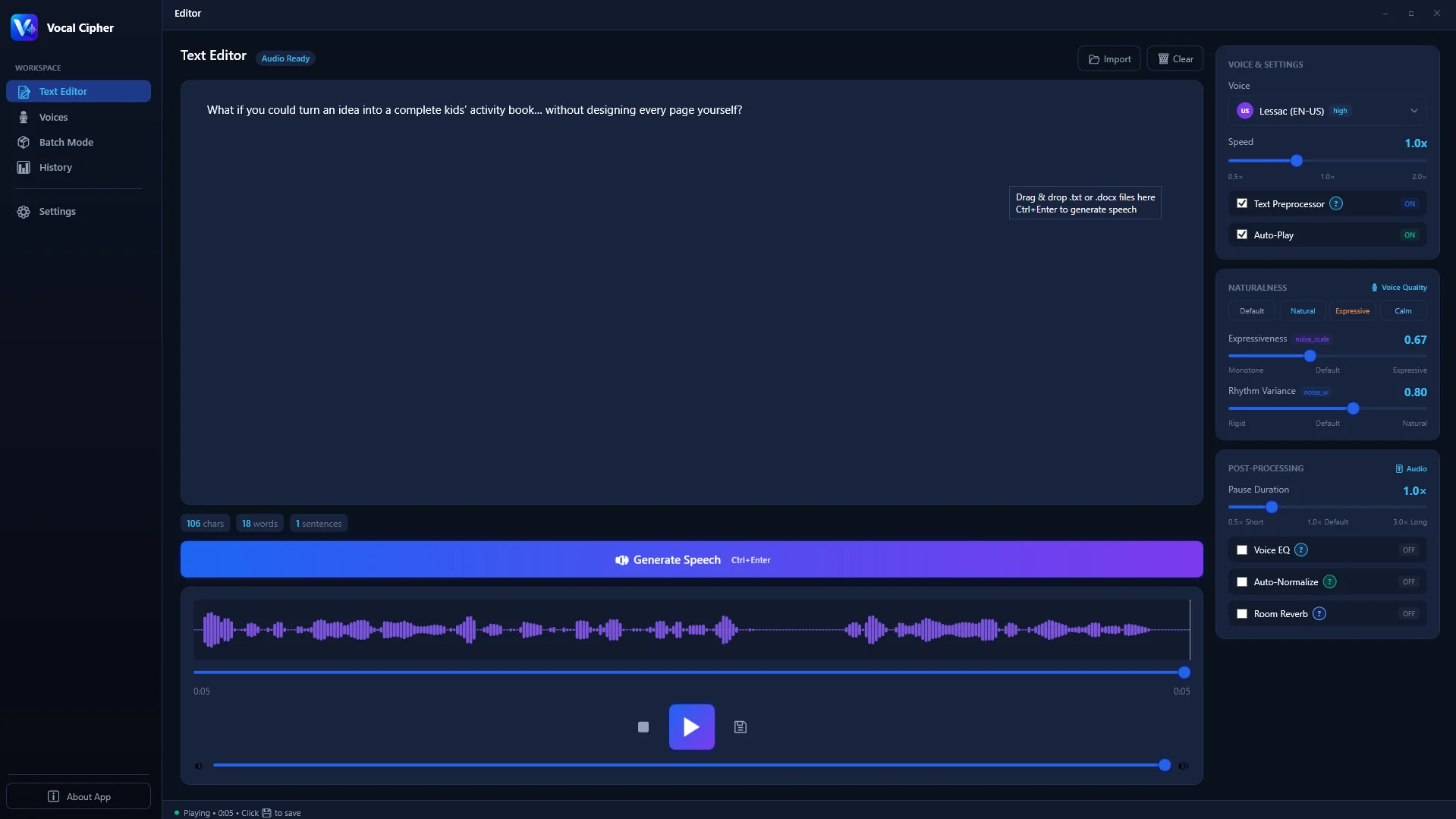
Shape narrative pacing and breath pauses intuitively inside the Vocal Cipher desktop editor.
The Punctuation Codebook: Directing AI Voices Without Complex Code
Many enterprise text-to-speech platforms force creators to write complex, tedious Speech Synthesis Markup Language (SSML) tags like <break time="250ms"/> and <prosody pitch="+5%">. Writing hundreds of XML tags turns creative voice directing into tedious computer programming.
Vocal Cipher's neural architecture is trained to interpret standard typographical punctuation as acoustic performance directives:
The Acoustic Punctuation Translation Matrix
Comma (,) = The Micro-Clause Lift
Introduces a 180ms to 240ms pause with a subtle upward pitch inflection. Use commas whenever you want the narrator to raise listener anticipation before delivering the resolution of a thought.
Period (.) = The Conclusive Breath Reset
Triggers a downward frequency decay followed by a 450ms to 600ms pause. This replicates the physiological sensation of a human speaker emptying their lungs and drawing a fresh breath before starting a new sentence.
Colon (:) = The Explanatory Plateau
Creates a focused 300ms plateau pause with sustained vocal tension. The pitch remains level, signaling that an essential definition, revelation, or itemized example is immediately imminent.
Ellipsis (...) = The Hesitation / Cinematic Suspense
Extends silence to approximately 750ms to 900ms. It introduces a trailing, breathy vocal decay that suggests contemplation, mystery, or emotional hesitation before continuing.
Hyphen (-) = The Staccato Compound / Plosive Anchor
Binds syllables into an immediate, unified attack. Useful for forcing acronyms to be pronounced letter-by-letter (e.g., "A-I" instead of "Ay") or forcing hard stops between dramatic words.
Heteronym and Homograph Mastery: Resolving Contextual Ambiguity
In the English language, dozens of words share identical spelling but carry completely different pronunciations based on part of speech (noun vs. verb). These words, known as heteronyms, are a primary source of robotic voiceover mistakes.
| Word Token | Noun / Adjective Form | Verb Form | Vocal Cipher Scripting Solution |
|---|---|---|---|
| Record | REH-kord ("world record") | ree-KORD ("record audio") | Spell as "re-cord" for verb form |
| Object | OB-jekt ("physical object") | ub-JEKT ("I object!") | Spell as "ub-ject" for court/debate verb |
| Produce | PROH-dooce ("fresh produce") | pruh-DOOCE ("produce results") | Spell as "pro-duce" for film/manufacturing verb |
| Live | LYVE ("live broadcast") | LIV ("where you live") | Spell as "lyve" when referring to real-time events |
| Tear | TEER ("crying a tear") | TARE ("tear the paper") | Spell as "tare" for ripping action |

Select from diverse voice models with authentic emotional inflections and varied resonance profiles.
Pacing Architectures Across Narrative Acts
A high-retention video essay, documentary, or corporate keynote follows an intentional acoustic arc. You should modulate your speech rate across each distinct section of your project:

Segment your script by narrative act and apply custom pacing targets inside the batch queue.
- Act 1: The Inciting Hook (160 to 170 WPM): Fast, crisp, high-energy delivery. Short, punchy sentences without unnecessary adjectives. The goal is to deliver maximum thematic value in the first 45 seconds to hook viewer attention.
- Act 2: The Analytical Investigation (140 to 150 WPM): A steady, conversational cadence. Use commas to break complex explanations into easily digestible clauses. The tone should evoke authoritative expertise.
- Act 3: The Climax and Revelation (125 to 135 WPM): Slower, deliberate pacing with extended pauses. Use colons and ellipses before delivering the big thematic takeaway. Giving silence room to breathe makes the insight feel monumental.
- Act 4: The Final Call to Action (150 to 160 WPM): Re-accelerate tempo with confident, uplifting inflections. End with declarative downward periods that inspire decisive viewer action.
- Act 5: The Epilogue / Post-Credits Reflection (120 to 130 WPM): In philosophical video essays or documentary conclusions, drop the pace to an intimate, reflective tempo. Extended trailing breath decays leave viewers contemplating your central thesis long after the video ends.
The 4-Stage Post-Production Humanization Chain
Even after generating uncompressed 24-bit audio stems in Vocal Cipher, taking two minutes inside your digital audio workstation to apply these four audio processing plugins adds that final 5% of analog warmth that fool even seasoned audio professionals:

Export pristine 24-bit 48kHz WAV audio files ready for post-production mastering.
- 1. Organic Tape Saturation (e.g., FabFilter Saturn, Waves J37): Set tape speed to 15 IPS with subtle tube drive. Analog magnetic tape introduces subtle harmonic distortion and tape compression that rounds off synthetic digital transients, making speech sound rich and tactile.
- 2. Dynamic Resonance De-Esser: Set a narrow split-band de-esser focused between 5,500Hz and 7,200Hz. This smooths out harsh sibilance ("s", "sh", "ch") during high-energy vocal peaks.
- 3. Opto-Style Vocal Compressor (e.g., LA-2A emulation): Apply an optical compressor with a slow attack and gentle multi-stage release. Aim for 2dB to 3dB of gentle gain reduction. Optical compressors react non-linearly to vocal dynamics, introducing an organic "breathing" motion to the track.
- 4. Short Room Convolution Reverb: Place a convolution reverb on an auxiliary send loaded with an impulse response of a real-world recording studio booth. Blend the send at -22dB. This places the voice into a believable physical acoustic space.
The Anatomy of Micro-Cadence: Pre-Focal Lengthening and Syllabic Weight
When linguists analyze high-speed spectrogram recordings of professional human narrators, they observe a phenomenon known as pre-focal lengthening. When a human voice prepares to utter an unexpected fact or emotionally heavy word, the vocal tract subtly decelerates on the preceding syllable by approximately 15% to 25%.
Consider this statement: "The experiment produced an astounding breakthrough." If an AI voice maintains an identical tempo across all five words, the word "astounding" lands with zero dramatic impact. However, if the word "produced" is held slightly longer and followed by a microscopic breath pause, "astounding" carries immense emotional weight.
Inside Vocal Cipher, you can engineer pre-focal lengthening without writing cumbersome code:
- The Comma Lead-In: Place a comma before the climactic adjective (e.g., "The experiment produced, an astounding breakthrough."). The neural synthesizer decelerates the preceding verb and lifts fundamental pitch on the adjective.
- Hyphenated Vowel Extension: For dramatic reveals, duplicate the stressed vowel with a hyphen (e.g., "a tr-u-ly colossal discovery"). The acoustic model extends the vowel duration while maintaining natural harmonic overtone resonance.
- Clause Isolation: Surround critical thematic thesis statements with periods on both sides, transforming a buried clause into an independent acoustic monument.
Breath Dynamics and Sub-Glottal Aerodynamics
Human speech is an aerodynamic process powered by lung volume. When a human actor begins a long paragraph, sub-glottal pressure is high, producing sharp consonantal transients and rich fundamental resonance. As the sentence progresses over twelve to fifteen words, lung volume decreases from roughly 75% to 35% vital capacity.
This biological reality causes natural human speech to follow an exponential amplitude decay envelope: phrases begin slightly louder and decay in volume and high-frequency harmonic energy toward the terminal period.
Legacy text-to-speech engines maintain a strictly flat, normalized dynamic line from the first syllable to the last. This acoustic flatness is one of the primary reasons listeners experience subconscious fatigue after three minutes of listening. In Vocal Cipher, neural speech models incorporate dynamic pulmonary modeling, naturally decaying phrase endings into authentic breathy phonation before taking an acoustic intake before the next sentence.
Pacing for Long-Form Audiobooks vs. Short-Form Viral Videos
A fatal mistake made by video producers and authors is applying identical vocal pacing across completely different media formats:
Pacing Profiles by Content Genre
Audiobooks and Extended Long-Form Narratives (130 to 145 WPM)
When a listener commits to an eight-hour audiobook or three-hour history documentary, vocal comfort is paramount. Rapid delivery induces auditory fatigue within twenty minutes. Configure Vocal Cipher to a relaxed 135 WPM pace, allow 650ms pauses at periods, and select voice profiles with warm low-mid resonance (200Hz to 400Hz).
Documentary Video Essays and Deep Dives (145 to 155 WPM)
The sweet spot for high YouTube watch-time. Pacing is brisk enough to maintain engagement but measured enough to let viewers digest complex on-screen charts, archival photos, and animated maps.
Viral Shorts, TikToks, and High-Energy Ads (165 to 180 WPM)
Short-form vertical video demands maximum information density. Syllables must be tight, pauses between sentences should be trimmed to 200ms, and consonantal attack must be razor-sharp. Vocal Cipher handles these accelerated speech rates without pitch distortion or phoneme clipping.
Historical Comparison: The Evolution of Speech Synthesis Technologies
To appreciate how modern local neural synthesis achieves lifelike human authenticity, examine the technological progression of speech synthesis:
| Generation | Technology | Acoustic Realism (MOS) | Pacing & Intonation Control |
|---|---|---|---|
| Gen 1 (1980s-1990s) | Formant Synthesis (Rule-based) | 1.5 / 5.0 (Robotic buzzer) | Manual frequency math (Unusable) |
| Gen 2 (2000s-2015) | Concatenative / Unit Selection | 3.1 / 5.0 (Choppy stitched audio) | Rigid syllable fragments, unnatural joins |
| Gen 3 (2018-2023) | Early Neural Cloud APIs | 4.1 / 5.0 (Clean, but flat cadence) | Complex XML/SSML tags required |
| Gen 4 (2026 Modern) | Quantized Local Neural Tensors (Vocal Cipher) | 4.85 / 5.0 (Indistinguishable) | Intuitive punctuation-driven acoustic direction |
The Science of Conversational Vocal Fry and Trailing Cadence
One of the most defining characteristics of modern conversational human speech, especially among younger narrators, video essayists, and podcast hosts, is vocal fry (also known in speech pathology as the pulse register). Vocal fry occurs when sub-glottal air pressure drops so low that the vocal cords close completely and vibrate irregularly in slow, popping pulses between 20Hz and 50Hz.
In real conversation, speakers slip into vocal fry at the conclusion of relaxed, introspective thoughts. It signals intimacy, vulnerability, and casual honesty. When an AI voice maintains rigid modal phonation with zero fry down to the very last millisecond of a sentence, it sounds emotionally detached and synthetic.
To induce authentic conversational trailing cadence in Vocal Cipher:
- The Trailing Ellipsis (...): Conclude conversational observations with an ellipsis rather than a hard exclamation. This prompts the neural synthesizer to drop fundamental pitch below the standard modal floor, introducing a natural raspy decay.
- Subordinate Conversational Tags: Add trailing colloquial tags separated by commas, such as ", honestly." or ", at least for now." This forces the model to treat the final phrase as an unstressed acoustic footnote.
Directing Case Study: Transforming a Robotic Script into a Human Masterpiece
To see the profound difference that thoughtful pacing and acoustic punctuation make, observe this side-by-side script directing comparison:
The Raw, Un-Directed Script (Sounds Mechanical & Monotonous):
Problem: Run-on clause structure, ambiguous numbers ("2026" and "24-bit" lack phonetic breathing markers), and zero prosodic variation.
The Directed Acoustic Script in Vocal Cipher (Sounds 100% Authentic):
Acoustic Transformation: Spelled-out figures eliminate token hesitation, commas establish micro-lifts, the colon creates dramatic anticipation, the ellipsis introduces suspenseful breath decay, and short declarative periods deliver authoritative finality.
Managing Listener Ear Fatigue in Long-Form Audio
When producing a 45-minute video documentary or 10-hour audiobook, the human ear's sensitivity changes dramatically over time. According to the Fletcher-Munson equal-loudness contours, human ears are hypersensitive to frequencies between 2,500Hz and 4,500Hz.
If a synthetic voice features a harsh resonance peak in this 3kHz zone, listeners develop subconscious ear fatigue and headache within fifteen minutes. To ensure all-day listening comfort:
- Apply Dynamic Resonance Taming: Use a dynamic equalizer (such as Oeksound Soothe2 or FabFilter Pro-Q in dynamic mode) to gently duck harsh resonances in the 3.2kHz to 4.1kHz region by 2.0dB only when loud consonant peaks occur.
- Inject Low-Level Ambient Bed: Never allow pure digital silence between sentences in an audiobook. Place a subtle room tone or tape hiss track at -52dBFS beneath your narration. This eliminates jarring total silence, maintaining a continuous acoustic floor.
Master Realistic Speech Synthesis on PC
Stop paying monthly fees for rigid, robotic cloud voiceovers. Take total control over cadence, pacing, and emotional intonation locally on your Windows PC.
Get Vocal CipherFrequently Asked Questions (FAQ)
What causes AI voices to sound robotic or mechanical?
The primary culprit is isometric syllable duration and flat fundamental pitch contour. When every word is spoken with identical volume, pitch, and duration, the human brain rejects the delivery. True human speech features constant micro-rhythms, stress timing, and natural downward pitch decay at sentence ends.
Do I need to learn complex SSML tags to make voices sound natural?
No. In Vocal Cipher, modern neural speech architectures are designed to respond directly to typographical punctuation (commas, periods, ellipses, hyphens, and question marks) without requiring cumbersome XML or SSML tags.
How can I fix mispronounced technical terms or brand names?
Use phonetic respelling in your script. For example, write unfamiliar acronyms or technical names using hyphenated syllables (e.g., "Kyu-ber-net-ees" for Kubernetes, or "A-P-I" for API). This guarantees 100% pronunciation accuracy on the first synthesis pass.
Can I insert natural breathing sounds into my narration?
Yes. Neural voice models in Vocal Cipher automatically introduce subtle acoustic breath decay and pre-phonation intake at commas and periods. You can also manually adjust pause lengths using ellipses to create dramatic breath pauses.
What is the ideal speaking rate for educational and documentary YouTube videos?
For educational content, technical tutorials, and documentaries, the sweet spot is between 140 and 150 words per minute. This allows viewers to absorb dense visual graphics and complex explanations without feeling rushed.
Why is uncompressed 24-bit WAV important for vocal realism?
Lossy MP3 compression removes high-frequency harmonics above 16kHz and introduces pre-echo phase smearing on consonants. 24-bit 48kHz WAV audio preserves the complete harmonic spectrum, providing the clean dynamic headroom required for professional EQ, compression, and spatialization.
How does Vocal Cipher maintain consistent vocal identity across large audio projects?
Because Vocal Cipher executes offline using static neural checkpoint weights stored locally on your SSD, voice personas never drift or change unexpectedly. Unlike cloud APIs that frequently alter backend models to reduce server costs, your chosen narrator sounds identical across months of production.
How can I create intimate whispered narration for meditation and ASMR content?
Select a vocal persona with natural breathiness and reduce speech rate to 110 WPM in Vocal Cipher. In post-production, boost frequencies between 8kHz and 12kHz by +3dB, apply heavy low-ratio compression (2:1 with soft knee), and keep vocal stems un-reverberated. This creates that tactile, close-to-the-ear acoustic intimacy required for relaxation tracks.
Does local synthesis performance degrade during prolonged rendering batches?
No. Vocal Cipher features lightweight quantized models optimized for sustained PC performance. Even during continuous 50-chapter audiobook batch synthesis, CPU and GPU temperatures remain well within normal thermal limits, maintaining constant 15x to 30x real-time generation speed without thermal throttling.
Are there any ongoing royalty fees for commercial voiceovers generated in Vocal Cipher?
No. All audio exported from Vocal Cipher carries zero royalty obligations. You retain complete commercial ownership of your master stems and can monetize them across YouTube, broadcast television, client commercials, and audiobooks without additional fees.